


Page 77 - policy and procedure infection control
P. 77
Policies and Procedures on Infection Control


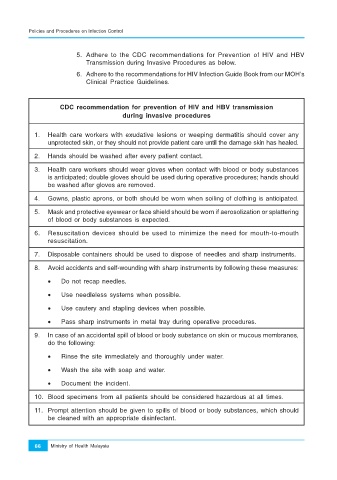
                             5. Adhere to the CDC recommendations for Prevention of HIV and HBV
                                Transmission during Invasive Procedures as below.
                             6. Adhere to the recommendations for HIV Infection Guide Book from our MOH’s
                                Clinical Practice Guidelines.


                        CDC recommendation for prevention of HIV and HBV transmission
                                           during invasive procedures


                 1.  Health care workers with exudative lesions or weeping dermatitis should cover any
                     unprotected skin, or they should not provide patient care until the damage skin has healed.

                 2.  Hands should be washed after every patient contact.
                 3.  Health care workers should wear gloves when contact with blood or body substances
                     is anticipated; double gloves should be used during operative procedures; hands should
                     be washed after gloves are removed.

                 4.  Gowns, plastic aprons, or both should be worn when soiling of clothing is anticipated.
                 5.  Mask and protective eyewear or face shield should be worn if aerosolization or splattering
                     of blood or body substances is expected.

                 6.  Resuscitation devices should be used to minimize the need for mouth-to-mouth
                     resuscitation.

                 7.  Disposable containers should be used to dispose of needles and sharp instruments.
                 8.  Avoid accidents and self-wounding with sharp instruments by following these measures:

                     •   Do not recap needles.
                     •   Use needleless systems when possible.

                     •   Use cautery and stapling devices when possible.
                     •   Pass sharp instruments in metal tray during operative procedures.

                 9.  In case of an accidental spill of blood or body substance on skin or mucous membranes,
                     do the following:
                     •   Rinse the site immediately and thoroughly under water.

                     •   Wash the site with soap and water.

                     •   Document the incident.
                 10. Blood specimens from all patients should be considered hazardous at all times.
                 11. Prompt attention should be given to spills of blood or body substances, which should
                     be cleaned with an appropriate disinfectant.


                 66   Ministry of Health Malaysia

