


Page 139 - Essentials of Nursing Leadership and Management, 5th Edition
P. 139
CikguOnline
         2208_Ch09_115-130.qxd  11/6/09  5:59 PM  Page 126
               126   unit 2 | Working Within the Organization                                                              CikguOnline
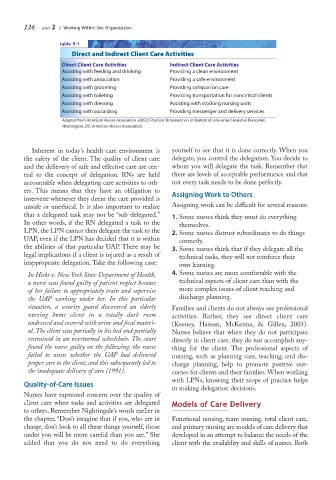
                          table 9-1
                              Direct and Indirect Client Care Activities
                           Direct Client Care Activities   Indirect Client Care Activities
                           Assisting with feeding and drinking  Providing a clean environment
                           Assisting with ambulation       Providing a safe environment
                           Assisting with grooming         Providing companion care
                           Assisting with toileting        Providing transportation for noncritical clients
                           Assisting with dressing         Assisting with stocking nursing units
                           Assisting with socializing      Providing messenger and delivery services
                           Adapted from American Nurses Association. (2002). Position Statement on Utilization of Unlicensed Assistive Personnel.
                           Washington, DC: American Nurses Association.


                  Inherent in today’s health-care environment is  yourself to see that it is done correctly. When you
               the safety of the client. The quality of client care  delegate, you control the delegation. You decide to
               and the delievery of safe and effective care are cen-  whom you will delegate the task. Remember that
               tral to the concept of delegation. RNs are held  there are levels of acceptable performance and that
               accountable when delegating care activities to oth-  not every task needs to be done perfectly.
               ers. This means that they have an obligation to
                                                            Assigning Work to Others
               intervene whenever they deem the care provided is
               unsafe or unethical. It is also important to realize  Assigning work can be difficult for several reasons:
               that a delegated task may not be “sub-delegated.”  1. Some nurses think they must do everything
               In other words, if the RN delegated a task to the  themselves.
               LPN, the LPN cannot then delegate the task to the  2. Some nurses distrust subordinates to do things
               UAP, even if the LPN has decided that it is within  correctly.
               the abilities of that particular UAP. There may be  3. Some nurses think that if they delegate all the
               legal implications if a client is injured as a result of  technical tasks, they will not reinforce their
               inappropriate delegation. Take the following case:  own learning.
                 In Hicks v. New York State Department of Health,  4. Some nurses are more comfortable with the
                 a nurse was found guilty of patient neglect because  technical aspects of client care than with the
                 of her failure to appropriately train and supervise  more complex issues of client teaching and
                 the UAP working under her. In this particular   discharge planning.
                 situation, a security guard discovered an elderly  Families and clients do not always see professional
                 nursing home client in a totally dark room  activities. Rather, they see direct client care
                 undressed and covered with urine and fecal materi-  (Keeney, Hasson, McKenna, & Gillen, 2005).
                 al. The client was partially in his bed and partially  Nurses believe that when they do not participate
                 restrained in an overturned wheelchair. The court  directly in client care, they do not accomplish any-
                 found the nurse guilty on the following: the nurse  thing for the client. The professional aspects of
                 failed to assess whether the UAP had delivered  nursing, such as planning care, teaching, and dis-
                 proper care to the client, and this subsequently led to  charge planning, help to promote positive out-
                 the inadequate delivery of care (1991).    comes for clients and their families.When working
                                                            with LPNs, knowing their scope of practice helps
               Quality-of-Care Issues
                                                            in making delegation decisions.
               Nurses have expressed concern over the quality of
               client care when tasks and activities are delegated  Models of Care Delivery
               to others. Remember Nightingale’s words earlier in
               the chapter, “Don’t imagine that if you, who are in  Functional nursing, team nursing, total client care,
               charge, don’t look to all these things yourself, those  and primary nursing are models of care delivery that
               under you will be more careful than you are.” She  developed in an attempt to balance the needs of the
               added that you do not need to do everything   client with the availablity and skills of nurses. Both

