


Page 119 - ANUAL REPORT MOH 2017
P. 119
HEALTH IMPACT ASSESSMENT OF AIR POLLUTION
             In 2017, EHU focus on capacity building for estimation of disease burden due to air pollution. In
             collaboration with WHO expert, EHU conducted a workshop on calculation of disease burden due
             to air pollution using software Air Q+ produced by WHO. In total 25 participants from state health
             department and local universities had attended the workshop. In collaboration with Thematic Working
             Group on Air Quality of Regional Forum, EHU had estimated the disease burden due to air pollution
             for four areas (Kuala Lumpur, Johor Bahru, Melaka Tengah, and Kuching). In addition, in 2017 EHU
             had conducted the health risk assessment of particulate matter (PM10) exposure during haze among
             adult population based on physical activity pattern. The aim of the health risk assessment was to
             determine the acceptable duration for performing outdoor physical activity during haze as measured
             by Air Pollutant Index (API) level.


             DISEASE SURVEILLANCE SECTOR
             •   Influenza Surveillance Programme
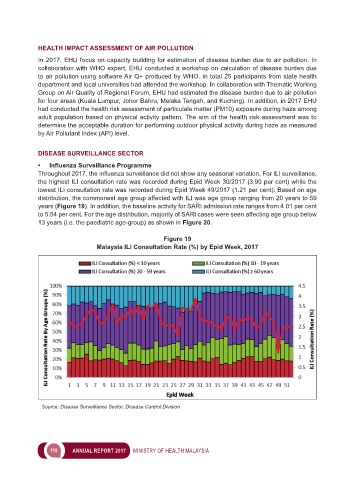
             Throughout 2017, the influenza surveillance did not show any seasonal variation. For ILI surveillance,
             the highest ILI consultation rate was recorded during Epid Week 30/2017 (3.90 per cent) while the
             lowest ILI consultation rate was recorded during Epid Week 49/2017 (1.21 per cent). Based on age
             distribution, the commonest age group affected with ILI was age group ranging from 20 years to 59
             years (Figure 19). In addition, the baseline activity for SARI admission rate ranges from 4.01 per cent
             to 5.54 per cent. For the age distribution, majority of SARI cases were seen affecting age group below
             13 years (i.e. the paediatric age-group) as shown in Figure 20.

                                                     Figure 19
                                Malaysia ILI Consultation Rate (%) by Epid Week, 2017


               Source: Disease Surveillance Sector, Disease Control Division


                 118    ANNUAL REPORT 2017     MINISTRY OF HEALTH MALAYSIA

