


Page 408 - ANUAL REPORT MOH 2017
P. 408
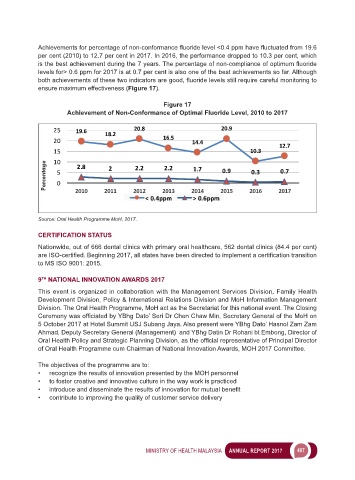
Achievements for percentage of non-conformance fluoride level <0.4 ppm have fluctuated from 19.6
             per cent (2010) to 12.7 per cent in 2017. In 2016, the performance dropped to 10.3 per cent, which
             is the best achievement during the 7 years. The percentage of non-compliance of optimum fluoride
             levels for> 0.6 ppm for 2017 is at 0.7 per cent is also one of the best achievements so far. Although
             both achievements of these two indicators are good, fluoride levels still require careful monitoring to
             ensure maximum effectiveness (Figure 17).

                                                     Figure 17
                      Achievement of Non-Conformance of Optimal Fluoride Level, 2010 to 2017

                  25     19.6      18.2     20.8                        20.9
                  20                                 16.5     14.4                        12.7
                  15                                                             10.3
                  10
                Percentage  5  2.8  2       2.2      2.2       1.7      0.9      0.3       0.7


                   0
                                  2011
                                                     2013
                         2010
                                            2012
                                                               > 0.6ppm
                                               < 0.4ppm       2014     2015      2016     2017
             Source: Oral Health Programme MoH, 2017.

             CERTIFICATION STATUS
             Nationwide, out of 666 dental clinics with primary oral healthcare, 562 dental clinics (84.4 per cent)
             are ISO-certified. Beginning 2017, all states have been directed to implement a certification transition
             to MS ISO 9001: 2015.

             9  NATIONAL INNOVATION AWARDS 2017
              TH
             This event is organized in collaboration with the Management Services Division, Family Health
             Development Division, Policy & International Relations Division and MoH Information Management
             Division. The Oral Health Programme, MoH act as the Secretariat for this national event. The Closing
             Ceremony was officiated by YBhg Dato’ Seri Dr Chen Chaw Min, Secretary General of the MoH on
             5 October 2017 at Hotel Summit USJ Subang Jaya. Also present were YBhg Dato’ Hasnol Zam Zam
             Ahmad, Deputy Secretary General (Management)  and YBhg Datin Dr Rohani bt Embong, Director of
             Oral Health Policy and Strategic Planning Division, as the official representative of Principal Director
             of Oral Health Programme cum Chairman of National Innovation Awards, MOH 2017 Committee.

             The objectives of the programme are to:
             •   recognize the results of innovation presented by the MOH personnel
             •   to foster creative and innovative culture in the way work is practiced
             •   introduce and disseminate the results of innovation for mutual benefit
             •   contribute to improving the quality of customer service delivery


                                                MINISTRY OF HEALTH MALAYSIA     ANNUAL REPORT 2017       407

