


Page 27 - alligood 8th edition_Neat
P. 27
8      UNIT I  Evolution of Nursing Theories

             Frameworks  and  theories  are  structures  about    BOX 1-2   Criteria for Development of the
           human beings and their health; these structures pro-    Professional Status of Nursing
           vide nurses with a perspective of the patient for profes-
           sional  practice.  Professionals  provide  public  service     1.  Utilizes in its practice a well-defined and well-
           in a practice focused on those whom they serve. The   organized body of specialized knowledge
           nursing process is useful in practice, but the primary   [that] is on the intellectual level of the higher
           focus  is  the  patient,  or  human  being.  Knowledge  of   learning
           persons, health, and environment forms the basis for    2.  Constantly enlarges the body of knowledge it
           recognition of nursing as a discipline, and this knowl-  uses and improves its techniques of education
           edge is taught to those who enter the profession. Every   and service through use of the scientific
           discipline  or  field  of  knowledge  includes  theoretical   method
           knowledge. Therefore, nursing as an academic disci-   3.  Entrusts the education of its practitioners to
           pline depends on the existence of nursing knowledge   institutions of higher education
           (Butts & Rich, 2011). For those entering the profes-   4.  Applies its body of knowledge in practical
           sion, this knowledge is basic for their practice in the   services vital to human and social welfare
           profession. Kuhn (1970), noted philosopher of science,    5.  Functions autonomously in the formulation of
           stated,  “The  study  of  paradigms . . .  is  what  mainly   professional policy and thereby in the control
           prepares the student for membership in the particular   of professional activity
           scientific community with which he [or she] will later    6.  Attracts individuals with intellectual and
           practice” (p. 11). This is significant for all nurses, but it   personal qualities of exalting service above
           is particularly important to those who are entering the   personal gain who recognize their chosen
           profession because “in the absence of a paradigm . . .   occupation as a life work
           all of the facts that could possibly pertain to the devel-   7.  Strives to compensate its practitioners by
           opment of a given science are likely to seem equally   providing freedom of action, opportunity for
           relevant” (Kuhn, 1970, p. 15). Finally, with regard to the   continuous professional growth, and economic
           priority of paradigms, Kuhn states, “By studying them   security
           and by practicing with them, the members of their cor-  Data from Bixler, G. K., & Bixler, R. W. (1959). The professional status of
           responding  community  learn  their  trade”  (Kuhn,   nursing. American Journal of Nursing, 59(8), 1142–1146.
           1970, p. 43). Master’s students apply and test theoreti-
           cal  knowledge  in  their  nursing  practice.  Doctoral
           students studying to become nurse scientists develop   These criteria have historical value for enhancing
           nursing theory, test theory, and contribute nursing sci-  our  understanding  of  the  developmental  path  that
           ence  in  theory-based  and  theory-generating  research   nurses followed. For example, a knowledge base that is
           studies.                                      well defined, organized, and specific to the discipline
                                                         was formalized during the last half of  the  twentieth
           Significance for the Profession               century,  but  this  knowledge  is  not  static.  Rather,  it
           Not only is theory essential for the existence of nursing   continues to grow in relation to the profession’s goals
           as an academic discipline, it is vital to the practice of   for the human and social welfare of the society that
           professional nursing. Recognition as a profession was    nurses  serve.  So  although  the  body  of  knowledge  is
           a  less  urgent  issue  as  the  twentieth  century  ended    important, the theories and research are vital to the
           because nurses had made consistent progress toward   discipline and the profession, so that new knowledge
           professional status through the century. Higher-degree   continues to be generated. The application of nursing
           nursing is recognized as a profession today having used   knowledge in practice is a criterion that is currently at
           the  criteria  for  a  profession  to  guide  development.   the  forefront,  with  emphasis  on  accountability  for
           Nursing  development  was  the  subject  of  numerous   nursing  practice,  theory-based  evidence  for  nursing
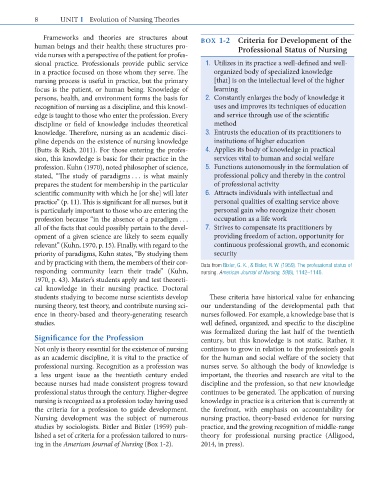
           studies by sociologists. Bixler and Bixler (1959) pub-  practice, and the growing recognition of middle-range
           lished a set of criteria for a profession tailored to nurs-  theory  for  professional  nursing  practice  (Alligood,
           ing in the American Journal of Nursing (Box 1-2).  2014, in press).

