


Page 37 - Creature Companion, September 2020
P. 37
www.creature-companions.in


         varieties living well in captivity.
         Neon Dwarf Rainbowfi sh,  Salmon
         Red    Rainbowfi sh,   Madgascar
         Rainbowfi sh,   and     Threadfi n

         Rainbowfish are some common
         species found in the pet industry. All
         the various species of Rainbowfi sh
         are quite similar with respect
         to feeding habits, desired water
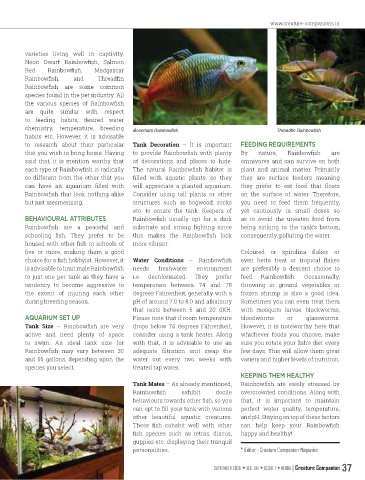
         chemistry, temperature, breeding   Bosemani Rainbowfi sh                        Threadfi n Rainbowfi sh
         habits etc. However, it is advisable
         to research about their particular   Tank Decoration – It is important   FEEDING REQUIREMENTS
         that you wish to bring home. Having   to provide Rainbowfish with plenty   By  nature,  Rainbowfi sh   are

         said that, it is mention worthy that   of decorations and places to hide.   omnivores and can survive on both
         each type of Rainbowfish is radically   The natural Rainbowfish habitat is   plant and animal matter. Primarily


         so different from the other that you   filled with aquatic plants, so they   they are surface feeders meaning
         can have an aquarium  fi lled  with   will appreciate a planted aquarium.   they prefer to eat food that  fl oats
         Rainbowfish that look nothing alike   Consider using tall plants or other   on the surface of water. Therefore,

         but just mesmerizing.             structures such as bogwood, rocks   you need to feed them frequently,
                                           etc. to ornate the tank. Keepers of   yet cautiously in small doses so
         BEHAVIOURAL ATTRIBUTES            Rainbowfish usually opt for a dark   as to avoid the uneaten food from


         Rainbowfish are a peaceful and     substrate and strong lighting since   being sinking to the tank’s bottom,

         schooling  fish. They prefer to be   this makes the Rainbowfi sh  look   consequently, polluting the water.
         housed with other fish in schools of   more vibrant.

         five or more, making them a good                                     Coloured or spirulina  fl akes  or

         choice for a fish hobbyist. However, it   Water Conditions – Rainbowfi sh   even betta treat or tropical  fl akes

         is advisable to limit male Rainbowfi sh   needs  freshwater  environment  are preferably a descent choice to
         to just one per tank as they have a   i.e.  dechlorinated.  They  prefer  feed  Rainbowfi sh.   Occasionally,
         tendency to become aggressive to   temperature between 74 and 78    throwing in ground vegetables or
         the extent of injuring each other   degrees Fahrenheit, generally with a   frozen shrimp is also a good idea.
         during breeding season.           pH of around 7.0 to 8.0 and alkalinity   Sometimes you can even treat them
                                           that rests between 5 and 20 dKH.   with mosquito larvae, blackworms,
         AQUARIUM SET UP                   Please note that if room temperature   bloodworms  or  glassworms.

         Tank Size – Rainbowfish are very   drops below 74 degrees Fahrenheit,   However, it is noteworthy here that
         active and need plenty of space   consider using a tank heater. Along   whichever foods you choose, make

         to swim. An ideal tank size for   with that, it is advisable to use an   sure you rotate your fish’s diet every

         Rainbowfish may vary between 30    adequate  filtration unit swap the   few days. This will allow them great

         and 55 gallons, depending upon the   water out every two weeks with   variety and higher levels of nutrition.
         species you select.               treated tap water.
                                                                             KEEPING THEM HEALTHY
                                           Tank Mates – As already mentioned,   Rainbowfish are easily stressed by

                                           Rainbowfi sh    exhibit    docile  overcrowded conditions. Along with
                                           behaviours towards other fish, so you   that, it is important to maintain


                                           can opt to fill your tank with various   perfect water quality, temperature,
                                           other beautiful aquatic creatures.   and pH. Staying on top of these factors
                                           These  fish cohabit well with other   can help keep your Rainbowfi sh

                                           fish species such as tetras, discus,   happy and healthy!

                                           guppies etc. displaying their tranquil
                                           personalities.                    * Editor - Creature Companion Magazine

                                                                    SEPTEMBER 2020 • VOL. XIII • ISSUE 7 • NOIDA | Creature Companion  37

