


Page 12 - FMT Dec Web
P. 12
Ingredients


          Grains in Weaning Foods


            By Dr. Pratima Awasthi* & Homi Joshi**


          IntRODuCtIOn                     ChARACtERIStICS OF A GOOD         feeding and is easily digested by the
          Malnutrition is the most common   WEAnInG FOOD                     child.
          problem in the developing countries   A good weaning food should be high
          and the condition is particularly   in nutrient density, rich in calories,   The  composition  of  the  food  must
          serious among infants. In many areas   adequate  in  good-quality  protein,   follow the guidelines and standards
          where  prolonged  breast-feeding  vitamins, and minerals, low viscosity,   recommended  by  competent
          is common, nutritional problems   low bulk density and appropriate   agencies, such as the Bureau of
          generally arise after the first year of   texture. The food, when stirred with   Indian Standards. WHO recommends
          life. Delayed supplementation and   cold, warm water or milk, should   that infants must start receiving
          inadequate consumption of weaning   form  a slurry  or  semisolid  mass  of   complementary foods at 6 months
          foods are major factors responsible   soft consistency, enabling the child   of age in addition to breast milk.
          for malnutrition. Although breast   to swallow it easily. Weaning food   Initially, they should be given
          milk is the perfect food to meet the   should be precooked and predigested   complementary foods 2–3 times
          energy and nutrient requirements   or processed in such a way that it   a day between 6–8 months and
          of an infant up to six months of life,   needs minimum  preparation before   increase to 3–4 times daily between
          it  is  insufficient  to  sustain  normal
          growth and needs of an infant, such
          as weaning foods.

          WEAnInG
          The word weaning comes from
          the word ‘weanion’ which means
          to accustom.  Generally,  weaning
          denotes a process in which semi-
          solid foods are introduced in
          an  infant’s  diet and thereafter,
          composition and consistency of diets
          gradually increase and breast milk
          gets completely replaced. Weaning
          foods are  complementary-  that  is,
          they complement the mother’s milk.
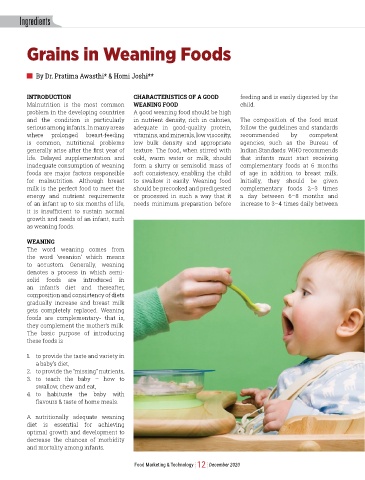
          The basic purpose of introducing
          these foods is

          1.   to provide the taste and variety in
            a baby’s diet,
          2.   to provide the “missing” nutrients,
          3.   to teach the baby – how to
            swallow, chew and eat,
          4.   to habituate the baby with
            flavours & taste of home meals.

          A nutritionally adequate weaning
          diet is essential for achieving
          optimal growth and development to
          decrease the chances of morbidity
          and mortality among infants.


                                           Food Marketing & Technology   12 December 2020

