


Page 37 - Year 3 SOW (2020)
P. 37
Primary Year 3 SK Scheme of Work
           2.  Suggested post-lesson tasks
           Below are 12 lesson tasks which teachers may choose from or adapt for the Post-lesson section within the Scheme of Work. These Post-lesson tasks
           are suitable for ending almost any skills-focused lesson. They are simple for pupils to participate in. Each Post-lesson task takes about 5–10 minutes of
           class time. Teachers can, of course, use their own Post-lesson tasks whenever they think that these would be more suitable for the pupils they teach.

           Please note that these tasks are the same for Primary Years 1–3. The language and vocabulary focus will be different, however, and some tasks can be
           modified for slightly more proficient pupils, as noted in the task description.


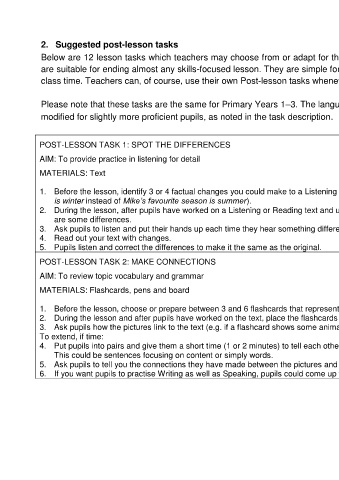
           POST-LESSON TASK 1: SPOT THE DIFFERENCES
           AIM: To provide practice in listening for detail
           MATERIALS: Text

           1.  Before the lesson, identify 3 or 4 factual changes you could make to a Listening or Reading text that pupils will work on in the lesson (e.g. Mike’s favourite season
              is winter instead of Mike’s favourite season is summer).
           2.  During the lesson, after pupils have worked on a Listening or Reading text and understood it, tell them they are going to listen to the text again but this time there
              are some differences.
           3.  Ask pupils to listen and put their hands up each time they hear something different from the original text, and to be ready to correct the difference.
           4.  Read out your text with changes.
           5.  Pupils listen and correct the differences to make it the same as the original.
           POST-LESSON TASK 2: MAKE CONNECTIONS
           AIM: To review topic vocabulary and grammar
           MATERIALS: Flashcards, pens and board

           1.  Before the lesson, choose or prepare between 3 and 6 flashcards that represent the content of a text that pupils will work on in the lesson.
           2.  During the lesson and after pupils have worked on the text, place the flashcards on the board and elicit ideas from pupils about items in the pictures.
           3.  Ask pupils how the pictures link to the text (e.g. if a flashcard shows some animals, the link may be The story is about a farm).
           To extend, if time:
           4.  Put pupils into pairs and give them a short time (1 or 2 minutes) to tell each other everything they can remember from the text, using the flashcards to help them.
              This could be sentences focusing on content or simply words.
           5.  Ask pupils to tell you the connections they have made between the pictures and the text.
           6.  If you want pupils to practise Writing as well as Speaking, pupils could come up to the board and write information under the corresponding flashcard.


                                                                                                                                                             17

