


Page 25 - Chamber PAC August 2018
P. 25
Vein Clinic

                                                              at the Regional Medical Center


      For individuals with leg pain, swelling, heaviness, restless legs and
      cramping, as well as varicose or spider veins, relief is available at the Vein Clinic
      at the Regional Medical Center. RMC’s highly skilled surgeons combine clinical expertise with the latest cosmetic and surgical
      techniques to return patients’ legs and feet to a more natural, youthful state. Vein treatments are performed on an outpatient
      basis at the Vein Clinic.

          WHAT ARE VARICOSE VEINS?
          Veins in your legs carry blood back to the heart through one-way check valves.
          When the veins become diseased, the valves no longer work properly, and a
          backflow or “reflux” of blood leaks backward down the leg causing the veins
          to bulge or balloon. These dilated or bulging veins are called varicose and may
          occur on or under the surface of the skin. This may cause leg pain, swelling,
          cramping and skin ulcerations.

          WHAT ARE SPIDER VEINS?
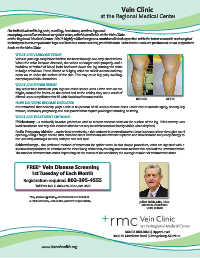
          Tiny red or blue bursts on your legs are called spider veins. Often seen on the
          thighs, around the knees, on the calves and at the ankles, they are a result of
          dilated venous capillaries that fill with blood and become visible.
                                                                                    BEFORE            AFTER
          HOW DO VEINS BECOME DISEASED?
          It is estimated that heredity plays a role in 80 percent of all venous disease cases. Other causes include aging, obesity, leg
          trauma, hormones, pregnancy, and occupations that require prolonged standing or sitting.
          WHAT ARE TREATMENT OPTIONS?
          Phlebectomy – a minimally invasive procedure used to remove varicose veins on the surface of the leg. Phlebectomy uses
          local anesthesia and tiny skin incisions that do not require stitches and are barely visible when they heal.

          Radio Frequency Ablation – under local anesthesia, a thin catheter is inserted into the Great Saphenous Vein through a small
          opening, using a single needle stick. With the aid of ultrasound, the catheter is placed and delivers radio frequency energy to
          the vein wall, causing it to heat, collapse and seal shut.

          Schlerotherapy – the preferred method of treatment for spider veins. In this simple procedure, veins are injected with a
          solution that produces an irritation to the inner lining of the vein, causing scar tissue to form that seals off the unwanted veins.
          The number of treatments varies depending on the extent of the condition; the average number of treatments is three.


                         *
                 FREE  Vein Disease Screening
                    1st Tuesday of Each Month

               Registration required. 803-395-4555
                      Toll Free in S.C. 800-476-3377, ext. 4555


                   *Any follow-up testing or treatment as a result of
                   a FREE screening will be the patient’s responsibility.
                                                                                      Julius Babb, MD, FACS
                                                                                       MEDICAL DIRECTOR
                                                                                          VEIN CLINIC


                                                                             ANNEX BUILDING | Upper Level
                                                                      3000 St. Matthews Road | Orangeburg, SC 29118


                          www.trmchealth.org

