


Page 5 - St Giles Catesby booklet MC StG 20210723 e-flip_Neat
P. 5
Mark Catesby


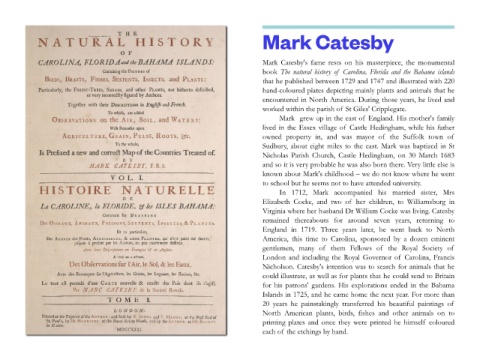
                                                                                                                 Mark  Catesby's  fame  rests  on  his  masterpiece,  the  monumental
                                                                                                                 book The natural history of  Carolina, Florida and the Bahama islands
                                                                                                                 that he published between 1729 and 1747 and illustrated with 220

                                                                                                                 hand-coloured plates depicting mainly plants and animals that he
                                                                                                                 encountered in North America. During those years, he lived and

                                                                                                                 worked within the parish of St Giles' Cripplegate.
                                                                                                                        Mark  grew up in the east of England. His mother's family

                                                                                                                 lived in the Essex village of Castle Hedingham, while his father
                                                                                                                 owned  property  in,  and  was  mayor  of  the  Suffolk  town  of

                                                                                                                 Sudbury, about eight miles to the east. Mark was baptized in St
                                                                                                                 Nicholas  Parish  Church,  Castle  Hedingham,  on  30  March  1683

                                                                                                                 and so it is very probable he was also born there. Very little else is
                                                                                                                 known about Mark's childhood – we do not know where he went

                                                                                                                 to school but he seems not to have attended university.
                                                                                                                        In  1712,  Mark  accompanied  his  married  sister,  Mrs

                                                                                                                 Elizabeth  Cocke,  and  two  of  her  children,  to  Williamsburg  in
                                                                                                                 Virginia where her husband Dr William Cocke was living. Catesby

                                                                                                                 remained  thereabouts  for  around  seven  years,  returning  to
                                                                                                                 England  in  1719.  Three  years  later,  he  went  back  to  North
                                                                                                                 America,  this  time  to  Carolina,  sponsored  by  a  dozen  eminent

                                                                                                                 gentlemen,  many  of  them  Fellows  of  the  Royal  Society  of

                                                                                                                 London and including the Royal Governor of Carolina, Francis
                                                                                                                 Nicholson. Catesby's intention was to search for animals that he
                                                                                                                 could illustrate, as well as for plants that he could send to Britain

                                                                                                                 for his patrons' gardens. His explorations ended in the Bahama
                                                                                                                 Islands in 1725, and he came home the next year. For more than

                                                                                                                 20  years  he  painstakingly  transferred  his  beautiful  paintings  of
                                                                                                                 North  American  plants,  birds,  fishes  and  other  animals  on  to

                                                                                                                 printing plates and once they were printed he himself coloured
                                                                                                                 each of the etchings by hand.

