


Page 28 - Advanced Course
P. 28
KNX ADVANCED COURSE


                  1  General


                  1.1  Foreword

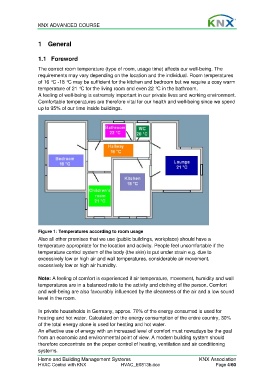
                  The correct room temperature (type of room, usage time) affects our well-being. The
                  requirements may vary depending on the location and the individual. Room temperatures
                  of 16 °C -18 °C may be sufficient for the kitchen and bedroom but we require a cosy warm
                  temperature of 21 °C for the living room and even 22 °C in the bathroom.
                  A feeling of well-being is extremely important in our private lives and working environment.
                  Comfortable temperatures are therefore vital for our health and well-being since we spend
                  up to 95% of our time inside buildings.


                  Figure 1: Temperatures according to room usage
                  Also all other premises that we use (public buildings, workplace) should have a
                  temperature appropriate for the location and activity. People feel uncomfortable if the
                  temperature control system of the body (the skin) is put under strain e.g. due to
                  excessively low or high air and wall temperatures, considerable air movement,
                  excessively low or high air humidity.

                  Note: A feeling of comfort is experienced if air temperature, movement, humidity and wall
                  temperatures are in a balanced ratio to the activity and clothing of the person. Comfort
                  and well-being are also favourably influenced by the cleanness of the air and a low sound
                  level in the room.

                  In private households in Germany, approx. 70% of the energy consumed is used for
                  heating and hot water. Calculated on the energy consumption of the entire country, 30%
                  of the total energy alone is used for heating and hot water.
                  An effective use of energy with an increased level of comfort must nowadays be the goal
                  from an economic and environmental point of view. A modern building system should
                  therefore concentrate on the proper control of heating, ventilation and air conditioning
                  systems.
                  Home and Building Management Systems                                    KNX Association
                  HVAC Control with KNX                HVAC_E0813b.doc                           Page 4/60

