


Page 108 - History of The Quranic Text | Kalamullah.Com
P. 108
88            THE HISTORY OF THE QUR'ANTe TEXT


                                     Hudhaifa bin al-Yaman's warning to the Caliph came in 25 A.H., and
                                   that very year 'Uthman resolved to end these disputes. Assembling the
                                   people, he explained the problem and sought their opinion on recital in
                                   different dialects, keeping in mind that some might claim a particular
                                   dialect as superior based on their tribal affiliations.' When asked for his
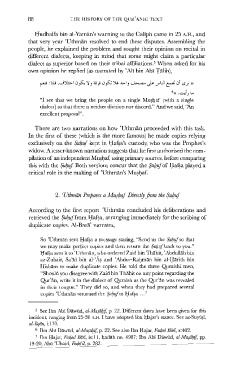
                                   own opinion he replied (as narrated by 'All bin Abi Talib),

                                       ~:W .J')b;.I2J~'1 J 4..i)2J~')U..b-IJ ~ J>'et'UI~2Ji lS))
                                                                                    6« . C-!i) L.
                                       "I see that we bring the people on a single MU~9-af [with a single
                                       dialect] so that there is neither division nor discord." And we said, "An
                                       excellent proposal".

                                     There are two narrations on how 'Uthman proceeded with this task.
                                   In the first of these (which is the more famous) he made copies relying
                                   exclusively on the Su&if kept in Hafsa's custody, who was the Prophet's
                                   widow. A lesser-known narration suggests that he first authorised the com-
                                   pilation of an independent Mushaf using primary sources, before comparing
                                   this with the Suhuf. Both versions concur that the Subujof Hafsa played a
                                   critical role in the making of 'Uthman's Mushaf


                                            2. 'Uthmiin Prepares a Musha] Directlyfrom the Suhuf


                                   According to the first report 'Uthman concluded his deliberations and
                                   retrieved the SulJuffrom Hafsa, arranging immediately for the scribing of
                                   duplicate copies. Al-Bara' narrates,

                                       So 'Uthman sent Hafsa a message stating, "Send us the $u~lIjso that
                                       we may make perfect copies and then return the $u~zifback to you."
                                       Hafsa sent it to 'Uthman, who ordered Zaid bin Thabit, 'Abdullah bin
                                       az-Zubair, Sa'Id bin al-'A~ and 'Abdur-Rahman bin al-Harith bin
                                       Hisham to make duplicate copies. He told the three Qjrraishi men,
                                       "Should you disagree with Zaid bin Thahit on any point regarding the
                                       Qur'an, write it in the dialect of Quraish as the Qur'an was revealed
                                       in their tongue." They did so, and when they had prepared several
                                       copies 'Uthman returned the Su~lIjto Hafsa ... 7

                                     5 See Ibn AbIDaW11d, al-M~1iJ;if, p. 22.Differentdates have been givenfor this
                                   incident, ranging from 25-30 A.H. I have adopted Ibn Hajar's stance. See as-Suyuti,
                                   al-Itqdn, i:170.
                                     6 Ibn AbIDawud, al-Masahi], p. 22. See also Ibn Hajar, Fatl;ul Ban,x:402.
                                     7 Ibn Hajar, Fathul Barf, ix.l l, hadlth no. 4987; Ibn AbI DaW11d, al-M~a~if, pp.
                                   19-20; Abu 'Ubaid, Far/.ii'il, p. 282.

