


Page 167 - History of The Quranic Text | Kalamullah.Com
P. 167
ARABIC PALAEOGRAPHY AND ORTHOGRAPHY IN THE QUR'AN    147

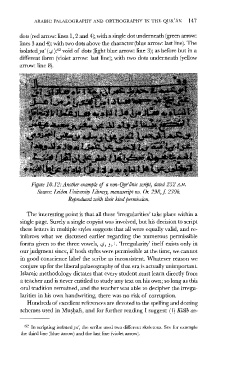
                           dots (red arrow: lines I, 2 and 4);with a single dot underneath (green arrow:
                          lines 3 and 4);with two dots above the character (blue arrow: last line). The
                           isolatedya' ((,>):62 void of dots ~ight blue arrow: line 3); as before but in a
                           different form (violet arrow: last line); with two dots underneath (yellow
                           arrow: line 8).


                              Figure 10.12: Another example if a non-Qyr'iinic script, dated 252 A.H.
                                 Source: Leiden University Library, manuscript no. Or. 298,] 239b.
                                           Reproduced with their kindpermission.


                             The interesting point is that all these 'irregularities' take place within a
                           single page. Surely a single copyist was involved, but his decision to script
                           these letters in multiple styles suggests that all were equally valid, and re-
                           inforces what we discussed earlier regarding the numerous permissible
                           forms given to the three vowels, (,>, ), \. 'Irregularity' itself exists only in
                           ourjudgment since, if both styles were permissible at the time, we cannot
                           in good conscience label the scribe as inconsistent. Whatever reason we
                           conjure up for the liberal palaeography of that era is actually unimportant.
                           Islamic methodology dictates that every student must learn directly from
                           a teacher and is never entitled to study any text on his own; so long as this
                           oral tradition remained, and the teacher was able to decipher the irregu-
                           larities in his own handwriting, there was no risk of corruption.
                             Hundreds of excellent references are devoted to the spelling and dotting
                           schemes used in Mushafs, and for further reading I suggest: (I) Kitiib an-


                            62 In scripting isolatedya', the scribe used two different skeletons. See for example
                           the third line (blue arrow) and the last line (violet arrow).

