


Page 246 - History of The Quranic Text | Kalamullah.Com
P. 246
226            THE HISTORY OF THE QUR'ANIC TEXT

                                   c.300    Closure of the Tosefta, corpus of supplementary material
                                            in exegesis and amplification of the Mishnah
                                   c.330    Pumbedita school headed by Abbaye, then Raba, lays
                                            foundation of Babylonian Talmud
                                   c.400    Talmud of the land of Israel completed as a systematic
                                            commentary on four of the Mishnah's six divisions, in
                                            particular Agriculture, Seasons, Women, and Damages
                                            (omitted: Holy Things and Purities)
                                   c.400    Rab Ashi begins to shape Babylonian Talmud, which is
                                            completed by 600
                                   630-640  Moslem conquest of Middle East
                                   c.700    Saboraim complete the fmal editing of Babylonian Talmud as
                                            a systematic commentary on four of the Mishnah's six
                                            divisions (excluded: Agriculture and Purities)

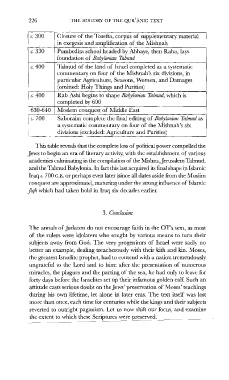
                                    This table reveals that the complete lossof political power compelled the
                                  Jews to begin an era of literary activity, with the establishment of various
                                  academies culminating in the compilation of the Mishna,Jerusalem Talmud,
                                  and the Talmud Babylonia. Infact this last acquired its fmal shape in Islamic
                                  Iraq c. 700 C.E. or perhaps even later (sinceall dates aside from the Muslim
                                  conquest are approximate), maturing under the strong influence of Islamic
                                  fiqh which had taken hold in Iraq six decades earlier.


                                                            3. Conclusion

                                  The annals of Judaism do not encourage faith in the OT's text, as most
                                  of the rulers were idolaters who sought by various means to turn their
                                  subjects away from God. The very progenitors of Israel were sadly no
                                  better an example, dealing treacherously with their kith and kin. Moses,
                                  the greatest Israelite prophet, had to contend with a nation tremendously
                                  ungrateful to the Lord and to him: after the presentation of numerous
                                  miracles, the plagues and the parting of the sea, he had only to leave for
                                  forty days before the Israelites set up their infamous golden calf. Such an
                                  attitude casts serious doubt on theJews' preservation of Moses' teachings
                                  during his own lifetime, let alone in later eras. The text itself was lost
                                  more than once, each time for centuries while the kings and their subjects
                                  reverted to outright paganism. Let us now shift our focus, and examine
                                  the extent to which these Scriptures were preserved.

