


Page 274 - History of The Quranic Text | Kalamullah.Com
P. 274
254           THE HISTORY OF THE QUR'ANIC TEXT

                                     Conclusivelyproving which scrollbelongs to which cave therefore becomes
                                  extremely difficult. Archaeology is not a precise science, in that a great
                                  many things can easily be interpreted one way or another. 115Additionally,
                                  different methods of carbon dating do result in conflicting conclusions
                                   (sometimes varying by centuries), so the reliability of such tests cannot be
                                  guaranteed.
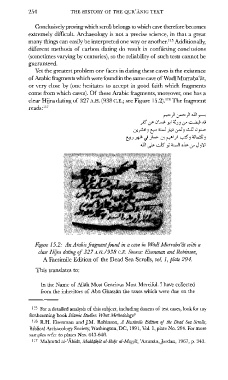
                                     Yet the greatest problem one faces in dating these caves is the existence
                                   of Arabic fragments which were found in the same cave of WadI Murraba'at,
                                   or very close by (one hesitates to accept in good faith which fragments
                                   come from which caves). Of these Arabic fragments, moreover, one has a
                                   clear Hijra dating of 327 A.H. (938 C.E.; see Figure 15.2).116 The fragment
                                   reads: 117
                                                                                 r-="'")\~)\.J.l\r
                                                                         .fi ,f ~\~ y.1 ~.JJ if ~ ~
                                                                       lJ!.?J C::' ~ fi~ ~J ~.)p
                                                                    e::u ~ J jl...>- J. ~\f.\...,...:5'J;u~J
                                                                         .J.l\ J.>-..::.15';; ~\.h if JJ)'\


                                     Figure 15.2: An Arabicfragmentjound in a cave in Wadi" Murraba'iii with a
                                      clear Hijra dating if 327 A.H./938 C.E. Source: Eisenman andRobinson,
                                       A Facsimile Edition of the Dead Sea Scrolls, vol. 1, plate 294.

                                     This translates to:

                                       In the Name of Allah Most Gracious Most Merciful. J have collected
                                       from the inheritors of Abu Ghassan the taxes which were due on the


                                    115 Fora detailedanalysis of thissubject, including dozens of testcases, lookformy
                                   forthcoming bookIslamic Studies: WhatMethodology?
                                    116 R.H. Eisenman and].M. Robinson, A Facsimile Edition if the Dead Sea Scrolls,
                                   Biblical Archaeology Society, Washington, DC, 1991, Vol. I, plateNo. 294. Formore
                                   samples referto plates Nos. 643-648.
                                    J17 Mahmild al-'AbidI, Makhtiitiit al-Bahial-Mayylt, 'Amman,jordan, 1967, p. 343.

