


Page 282 - History of The Quranic Text | Kalamullah.Com
P. 282
262           THE HISTORY OF THE QUR'ANIC TEXT


                                    the very outset of Israelite history. For example: (a) the Hebrew language
                                    was borrowed from the Phoenicians; (b) the Jews did not develop their
                                    own script, appropriating it instead from the Aramaic and the Assyrians;
                                    (c) the diacritical system of the Hebrew Torah was borrowed from the
                                    Arabic; (d) the Book of the Covenant (roughly Exodus 20:22-23: 19) was
                                    possibly adapted from the Code of Hammurabi, and so on.
                                      The text itself remained fluid till the 10th century C.E., nearly 2300
                                    years after Moses' death: fluid in that it remained open to alterations
                                    given sufficient doctrinaljustification. And once the change was complete,
                                    the original became 'defective' and was destroyed, eliminating all traces of
                                    a trail which might otherwise have led back to something older and more
                                    intact.
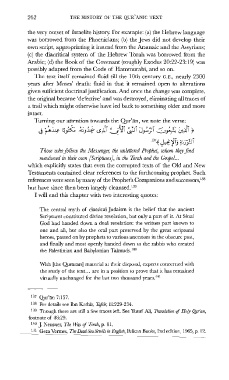
                                      Turning our attention towards the Qur'an, we note the verse:
                                        •• J ~ ~~<-~ J~ Jj;. ll" -\]1" ~II J "II -: '~' ~ II J.
                                       ~ ~    ,  .r-"'"  J., ->,  ~   I$"  J-..r.......:.-J~ (j..,  ')7
                                                                             J
                                                                              137£ 2'':11' "J-'~ll
                                                                                  I
                                                                                '{ ~ ~ J , 'J.J-'
                                        Those whoflllow the Messenger, the unlettered Prophet, whom they find
                                        mentioned in their own [Scriptures], in the Torah. andthe Gospel.:
                                    which explicitly states that even the corrupted texts of the Old and New
                                    Testaments contained clear references to the forthcoming prophet. Such
                                    references were seen by many of the Prophet's Companions and successors.!"
                                    but have since then been largely cleansed. 139
                                      I will end this chapter with two interesting quotes:

                                        The central myth of classicalJudaism is the belief that the ancient
                                        Scriptures constituted divine revelation, but only a part of it. At Sinai
                                        God had handed down a dual revelation: the written part known to
                                        one and all, but also the oral part preserved by the great scriptural
                                        heroes, passed on by prophets to various ancestors in the obscure past,
                                        and finally and most openly handed down to the rabbis who created
                                        the Palestinian and Babylonian Talmuds.U"
                                        With [the Qumran] material at their disposal,experts concerned with
                                        the study of the text... are in a position to prove that it has remained
                                        virtually unchanged for the last two thousand years.141


                                     137 Qur'an 7:157.
                                     138 Fordetails seeIbn Kathu, TafsTr, iii:229-234.
                                     139 Though there are still a fewtracesleft. SeeYusufAli, Translation qf Holy Qyr'an,
                                    footnote of 48:29.
                                     140 J. Neusner, The WiD' of Torah, p. 81.
                                     141 GezaVermes, The Dead Sea Scrolls inEnglish, Pelican Books, 2ndedition, 1965, p. 12.

