


Page 33 - History of The Quranic Text | Kalamullah.Com
P. 33
INTRODUCTION                       13

                              These will be pondered over the course of this work, to reveal not only
                            the following answers but also the logic which stipulates them:
                              a)  The Qur'an is the very Word of Allah, His [mal message to all
                                 humanity, revealed to His [mal messenger Muhammad and trans-
                                 cending all limitations of time and space. It ispreserved in its original
                                 tongue without any amendments, additions or deletions.
                              b) There will never be a discovery of a Qur'an, fragmented or whole,
                                 which differs from the consensus text circulating throughout the
                                 world. If it does differ then it cannot be regarded as Qur'an, because
                                 one of the foremost conditions for accepting anything as such is
                                 that it conform to the text used in 'Uthman's Mushaf"
                              c)  Certainly anyone can write on Islam, but only a devout Muslim
                                  has the legitimate prerogative to write on Islamic and its related
                                 subjects. Some may consider this biased, but then who is not? Non-
                                 followers cannot claim neutrality, for their writings swerve depending
                                 on whether Islam's tenets agree or disagree with their personal
                                  beliefs, and so any attempts at interpretation from Christians,]ews,
                                  atheists, or non-practicing Muslims must beunequivocally discarded.
                                  I may add that if any proffered viewpoint clashes with the Prophet's
                                  own guidelines, either explicitly or otherwise, it becomes objec-
                                  tionable; in this light even the writings of a devout Muslim may be
                                  rejected if they lack merit. This selectivity lies at the very heart of
                                  Ibn Sirin's golden rule (d. 110 A.H./728 C.E.):

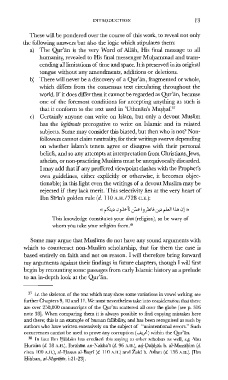
                                                      « ~~ 0 J .b-t ~ IJ;';lA,jI.~ r-W\ \..L. 0[»
                                      This knowledge constitutes your deen (religion), so be wary of
                                      whom you take your religion from."

                              Some may argue that Muslims do not have any sound arguments with
                            which to counteract non-Muslim scholarship, that for them the case is
                            based entirely on faith and not on reason. I will therefore bring forward
                            my arguments against their findings in future chapters, though I will first
                            begin by recounting some passages from early Islamic history as a prelude
                            to an in-depth look at the Qur'an,


                             37 i.e. the skeleton of the textwhichmay showsomevariations in vowel writing, see
                            furtherChapters 9, 10and II. Wemustnevertheless takeinto consideration that there
                            are over 250,000manuscripts of the Qur'an scattered all over the globe [see p. 316
                            note 38]. When comparing them it is always possible to find copyingmistakes here
                            and there; thisisan exampleof human fallibility, and has been recognised as suchby
                            authors who havewritten extensively on the subjectof "unintentionalerrors." Such
                            occurrences cannot be used to proveany corruption (...;..;..J.) withinthe Qur'an.
                             38 In fact Ibn Hibban has credited this sayingto other scholars as well, e.g. Abu
                            Huraira (d. 58 A.H.), Ibrahim an-Nakha'i (d. 96 A.H.), ad-Dahhak b. al-Muzahim (d.
                            circa 100A.H.), al-Hasan al-Basri (d. 110A.H.) and Zaid b. Aslam(d. 136 A.H.). [Ibn
                            Hibban, al-Majrii~ln, i:21-23].

