


Page 140 - Tafsir of surat at tawba repentance
P. 140
© Islamic Online University Usool at-Tafseer
conveyed by a large number of narrators on each level of the chain of narration
below the level of the sahaabah (the condition of tawaatur). Narrations which
had authentic chains but lacked the condition of tawaatur were accepted as
explanations (tafseer) of sahaabah, but were not considered as methods of
reciting the Qur’aan. As for narrations which did not even have an authentic chain
of narration, they were classified “baatil” (false) and rejected totally.
The second condition was that the recitations’ variations match known Arabic
grammatical constructions. Unusual cons-tructions were verified by their
existence in passages of pre-Islamic prose or poetry. The third condition required
the recitation to coincide with the script of one of the copies of Qur’aan
distributed during the era of Caliph ‘Uthmaan. Hence, differences which result
from dot placement (e.g. ta‘lamoon and ya‘lamoon) are considered acceptable,
provided the other conditions are met. If no support for an unusual condition
33
could be found, the recitation of that construction would be classified shaath.
This classification did not mean that all aspects of the recitation were considered
shaath; in fact, none of the accepted ten methods are totally free from some
shaath constructions. Shaath narrations of this type also serve as explanations for
the authentic narrations, as they are obviously statements of the sahaabah.
TAJWEED (PROPER QUR’AANIC RECITATION)
From the beginning of the final phase of prophethood, great stress was placed
on the recitation of the Qur’aan. The very name “Qur’aan” means a “reading” or
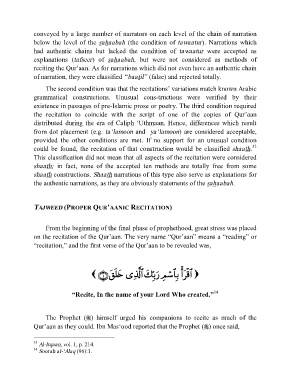
“recitation,” and the first verse of the Qur’aan to be revealed was,
( ÇÊÈ t,n=y{ Ï%©!$# y7În/u ÉOó$$Î/ ù&tø%$# )
34
“Recite, In the name of your Lord Who created.”
The Prophet (r) himself urged his companions to recite as much of the
Qur’aan as they could. Ibn Mas‘ood reported that the Prophet (r) once said,
33
Al-Itqaan, vol. 1, p. 214.
34
Soorah al-‘Alaq (96):1.
http://www.islamiconlineuniversity.com 21

