


Page 94 - Tafsir of surat at tawba repentance
P. 94
© Islamic Online University Usool at-Tafseer
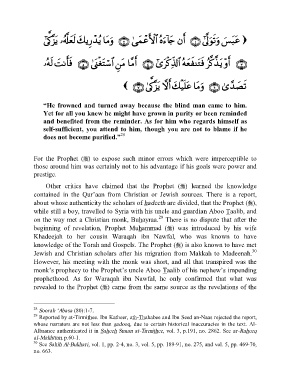
#ª1¨t ¼ã&©#yès9 y7Íôã $tBur ÇËÈ 4yJôãF{$# çnuä!%y` br& ÇÊÈ #¯<uqs?ur }§t6tã )
¼çms9 |MRr'sù ÇÎÈ 4Óo_øótFó$# Ç`tB $¨Br& ÇÍÈ #tø.Ïe%!$# çmyèxÿYtGsù ã©.¤t ÷rr& ÇÌÈ
( ÇÐÈ 4ª1¨t wr& y7øn=tã $tBur ÇÏÈ 3£|Ás?
“He frowned and turned away because the blind man came to him.
Yet for all you knew he might have grown in purity or been reminded
and benefited from the reminder. As for him who regards himself as
self-sufficient, you attend to him, though you are not to blame if he
28
does not become purified.”
For the Prophet (r) to expose such minor errors which were imperceptible to
those around him was certainly not to his advantage if his goals were power and
prestige.
Other critics have claimed that the Prophet (r) learned the knowledge
contained in the Qur’aan from Christian or Jewish sources. There is a report,
about whose authenticity the scholars of hadeeth are divided, that the Prophet (r),
while still a boy, travelled to Syria with his uncle and guardian Aboo Taalib, and
on the way met a Christian monk, Buhayraa. 29 There is no dispute that after the
beginning of revelation, Prophet Muhammad (r) was introduced by his wife
Khadeejah to her cousin Waraqah ibn Nawfal, who was known to have
knowledge of the Torah and Gospels. The Prophet (r) is also known to have met
30
Jewish and Christian scholars after his migration from Makkah to Madeenah.
However, his meeting with the monk was short, and all that transpired was the
monk’s prophecy to the Prophet’s uncle Aboo Taalib of his nephew’s impending
prophethood. As for Waraqah ibn Nawfal, he only confirmed that what was
revealed to the Prophet (r) came from the same source as the revelations of the
28
Soorah ‘Abasa (80):1-7.
29
Reported by at-Tirmithee. Ibn Katheer, ath-Thahabee and Ibn Seed an-Naas rejected the report,
whose narrators are not less than sadooq, due to certain historical inaccuracies in the text. Al-
Albaanee authenticated it in Saheeh Sunan at-Tirmithee, vol. 3, p.191, no. 2862. See ar-Raheeq
al-Makhtum, p.60-1.
30
See Sahih Al-Bukhari, vol. 1, pp. 2-4, no. 3, vol. 5, pp. 189-91, no. 275, and vol. 5, pp. 469-70,
no. 663.
http://www.islamiconlineuniversity.com 15

