


Page 35 - test2
P. 35
conducted a Geotap survey to determine the sand pore pressure.  The sand pore
                   pressure was determined to be 14.15 ppg.  BP also converted this pore pressure
                   to an estimated fracture gradient of 15.0 ppg.  The open‐hole section drilled
                   utilized a surface mud weight range of 14.1–14.5 ppg, which allowed for a safe
                   drilling margin to be maintained between pore pressure and fracture gradient.
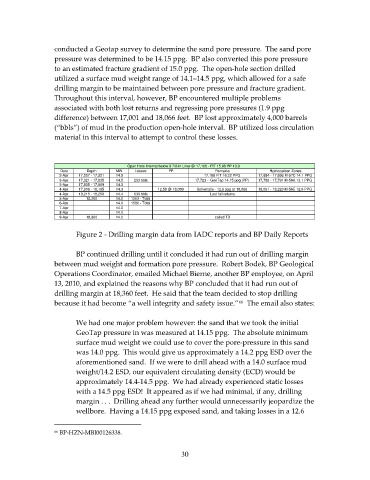
                   Throughout this interval, however, BP encountered multiple problems
                   associated with both lost returns and regressing pore pressures (1.9 ppg
                   difference) between 17,001 and 18,066 feet.  BP lost approximately 4,000 barrels
                   (“bbls”) of mud in the production open‐hole interval.  BP utilized loss circulation
                   material in this interval to attempt to control these losses.


                                           Open Hole Interval below 9 7/8-in Liner @ 17,168 - FIT 15.98 PP 13.9
                     Date     Depth    MW     Losses     PP             Remarks           Hydrocarbon Zones
                     2-Apr  17,007 - 17,321  14.3                    17,168 FIT 16.22 PPG  17,684 - 17,693 M-57C 14.1 PPG
                     3-Apr  17,321 - 17,835  14.5  233 bbls       17,723 -  GeoTap 14.15 ppg (PP)  17,786 - 17,791 M-56A 13.1 PPG
                     3-Apr  17,835 - 17,909  14.3
                     4-Apr  17,909 - 18,195  14.3    12.58 @ 18,089  Schematic - 12.6 ppg at 18,066  18,061 - 18,223 M-56E 12.6 PPG
                     4-Apr  18,215 - 18,250  14.4  639 bbls            Lost full returns
                     5-Apr    18,260   14.0  1263 - Total
                     6-Apr             14.0  1586 - Total
                     7-Apr             14.0
                     8-Apr             14.0
                     9-Apr    18,360   14.0                             called TD

                          Figure 2 ‐ Drilling margin data from IADC reports and BP Daily Reports

                          BP continued drilling until it concluded it had run out of drilling margin
                   between mud weight and formation pore pressure.  Robert Bodek, BP Geological
                   Operations Coordinator, emailed Michael Bierne, another BP employee, on April
                   13, 2010, and explained the reasons why BP concluded that it had run out of
                   drilling margin at 18,360 feet.  He said that the team decided to stop drilling
                   because it had become “a well integrity and safety issue.”   The email also states:
                                                                                66

                          We had one major problem however: the sand that we took the initial
                          GeoTap pressure in was measured at 14.15 ppg.  The absolute minimum
                          surface mud weight we could use to cover the pore‐pressure in this sand
                          was 14.0 ppg.  This would give us approximately a 14.2 ppg ESD over the
                          aforementioned sand.  If we were to drill ahead with a 14.0 surface mud
                          weight/14.2 ESD, our equivalent circulating density (ECD) would be
                          approximately 14.4‐14.5 ppg.  We had already experienced static losses
                          with a 14.5 ppg ESD!  It appeared as if we had minimal, if any, drilling
                          margin . . .  Drilling ahead any further would unnecessarily jeopardize the
                          wellbore.  Having a 14.15 ppg exposed sand, and taking losses in a 12.6


                   66  BP‐HZN‐MBI00126338.


                                                             30

