


Page 13 - IIUM Press Rights Catalogue 2020
P. 13
11


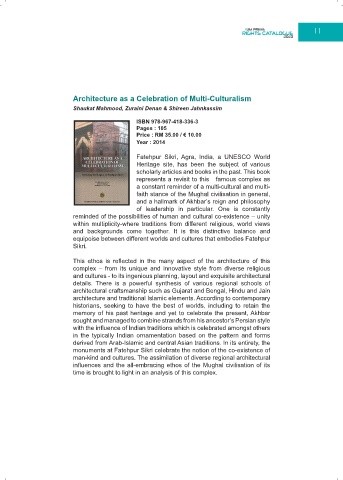
                      Architecture as a Celebration of Multi-Culturalism
                      Shaukat Mahmood, Zuraini Denan & Shireen Jahnkassim
                                         ISBN 978-967-418-336-3
                                         Pages : 105
                                         Price : RM 35.00 / € 10.00
                                         Year : 2014

                                         Fatehpur  Sikri,  Agra,  India,  a  UNESCO  World
                                         Heritage  site, has been the subject of various
                                         scholarly articles and books in the past. This book
                                         represents a revisit to this   famous complex as
                                         a constant reminder of a multi-cultural and multi-
                                         faith stance of the Mughal civilisation in general,
                                         and a hallmark of Akhbar’s reign and philosophy
                                         of  leadership  in  particular.  One  is  constantly
                      reminded of the possibilities of human and cultural co-existence – unity
                      within  multiplicity-where  traditions  from  different  religious,  world  views
                      and backgrounds  come together. It is this distinctive  balance  and
                      equipoise between different worlds and cultures that embodies Fatehpur
                      Sikri.

                      This  ethos  is  reflected  in  the  many  aspect  of  the  architecture  of  this
                      complex  –  from  its  unique  and  innovative  style  from  diverse  religious
                      and cultures - to its ingenious planning, layout and exquisite architectural
                      details.  There is  a  powerful synthesis of  various regional schools of
                      architectural craftsmanship such as Gujarat and Bengal, Hindu and Jain
                      architecture and traditional Islamic elements. According to contemporary
                      historians, seeking to have the best of worlds, including  to retain the
                      memory of his past heritage and yet to celebrate the present, Akhbar
                      sought and managed to combine strands from his ancestor’s Persian style
                      with the influence of Indian traditions which is celebrated amongst others
                      in the typically  Indian  ornamentation  based  on the pattern and  forms
                      derived from Arab-Islamic and central Asian traditions. In its entirety, the
                      monuments at Fatehpur Sikri celebrate the notion of the co-existence of
                      man-kind and cultures. The assimilation of diverse regional architectural
                      influences and the all-embracing ethos of the Mughal civilisation of its
                      time is brought to light in an analysis of this complex.

