


Page 23 - IIUM Press Rights Catalogue 2020
P. 23
21


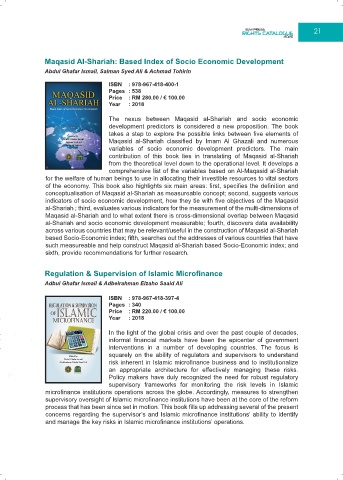
              Maqasid Al-Shariah: Based Index of Socio Economic Development
              Abdul Ghafar Ismail, Salman Syed Ali & Achmad Tohirin

                                 ISBN   : 978-967-418-400-1
                                 Pages  : 538
                                 Price  : RM 280.00 / € 100.00
                                 Year   : 2018

                                 The  nexus  between  Maqasid  al-Shariah  and  socio  economic
                                 development  predictors is considered  a new proposition. The book
                                 takes a step to explore the possible links between five elements of
                                 Maqasid  al-Shariah  classified  by  Imam  Al  Ghazali  and  numerous
                                 variables  of socio economic  development  predictors.  The main
                                 contribution  of  this  book  lies  in  translating  of  Maqasid  al-Shariah
                                 from the theoretical level down to the operational level. It develops a
                                 comprehensive list of the variables based on Al-Maqasid al-Shariah
              for the welfare of human beings to use in allocating their investible resources to vital sectors
              of the economy. This book also highlights six main areas: first, specifies the definition and
              conceptualisation of Maqasid al-Shariah as measureable concept; second, suggests various
              indicators of socio economic development, how they tie with five objectives of the Maqasid
              al-Shariah ; third, evaluates various indicators for the measurement of the multi-dimensions of
              Maqasid al-Shariah and to what extent there is cross-dimensional overlap between Maqasid
              al-Shariah and socio economic development measurable; fourth, discovers data availability
              across various countries that may be relevant/useful in the construction of Maqasid al-Shariah
              based Socio-Economic index; fifth, searches out the addresses of various countries that have
              such measureable and help construct Maqasid al-Shariah based Socio-Economic index; and
              sixth, provide recommendations for further research.


              Regulation & Supervision of Islamic Microfinance
              Adbul Ghafar Ismail & Adbelrahman Elzaho Saaid Ali

                                 ISBN   : 978-967-418-397-4
 regulation & supervision   regulation & supervision   Pages  : 340
 of islamic microfinance         Price  : RM 220.00 / € 100.00
                of  islamic
 In  the light of  the global crisis and over the past couple of  decades,
 informal  financial  markets have been the epicenter  of government   Year   : 2018
 interventions in a number of developing countries. The focus is squarely   microfinance
 on the ability of regulators and supervisors to understand risks inherent
 in Islamic microfinance business and to institutionalize an appropriate
 architecture for effectively  managing  these risks. Policy makers have
 duly recognized the need for robust regulatory and supervisory
 frameworks  for  monitoring the risk  levels in Islamic microfinance   regulation & supervision of islamic microfinance
 institutions  operations across the globe.  Accordingly, measures to
 strengthen supervisory oversight of Islamic microfinance  institutions   In the light of the global crisis and over the past couple of decades,
 have been at the core of the reform process that has been since set in
 motion. This book fills up those measures. It also comes up with guiding
 principles in addressing several of the present concerns regarding the
 supervisor’s and Islamic microfinance institutions’ ability to identify and   informal  financial  markets  have  been  the  epicenter  of  government
 manage the key risks in Islamic microfinance institutions’ operations.
 Abdul Ghafar Ismail, PhD. Professor of Islamic banking and financial
 economics,  Islamic  Research and  Training Institute,  Islamic   interventions in a number of  developing  countries.  The focus is
 Development Bank
 Abdelrahman  Elzahi Saaid Ali, PhD. Senior Research Economist,
 Islamic Research and Training Institute, Islamic Development Bank  squarely on the ability of regulators and supervisors to understand
                     Edited by
                    Abdul Ghafar Ismail
                  Abdelrahman Elzahi Saaid Ali  risk inherent in Islamic microfinance business and to institutionalize
                                 an appropriate architecture for  effectively managing these risks.
    IIUM Press
   Email: iiumbookshop@iium.edu.my
   Website: http://www.iium.edu.my/research
      http://iiumpress.iium.edu.my/bookshop  Policy makers have duly recognized the need for robust regulatory
                                 supervisory  frameworks for monitoring  the risk levels  in Islamic
              microfinance institutions operations across the globe. Accordingly, measures to strengthen
              supervisory oversight of Islamic microfinance institutions have been at the core of the reform
              process that has been since set in motion. This book fills up addressing several of the present
              concerns regarding the supervisor’s and Islamic microfinance institutions’ ability to identify
              and manage the key risks in Islamic microfinance institutions’ operations.

