


Page 8 - 1 english (ganesh chaure)
P. 8
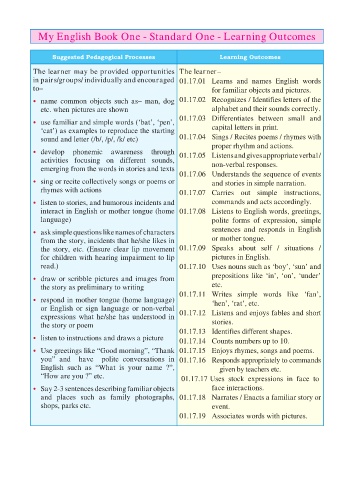
My English Book One - Standard One - Learning Outcomes


                        Suggested Pedagogical Processes                        Learning Outcomes

                 The learner may be provided opportunities  The learner–
                 in pairs/groups/ individually and encouraged  01.17.01  Learns and names English words
                 to–                                                         for familiar objects and pictures.
                 • name common objects such as– man, dog          01.17.02  Recognizes / Identifies letters of the
                    etc. when pictures are shown                             alphabet and their sounds correctly.
                                                                  01.17.03  Differentiates  between small and
                 • use familiar and simple words (‘bat’, ‘pen’,
                    ‘cat’) as examples to reproduce the starting             capital letters in print.
                    sound and letter (/b/, /p/, /k/ etc)          01.17.04  Sings / Recites poems / rhymes with
                                                                             proper rhythm and actions.
                 • develop  phonemic  awareness through           01.17.05  Listens and gives appropriate verbal /
                    activities  focusing on different  sounds,               non-verbal responses.
                    emerging from the words in stories and texts
                                                                  01.17.06  Understands the sequence of events
                 • sing or recite collectively songs or poems or             and stories in simple narration.
                    rhymes with actions                           01.17.07  Carries  out  simple  instructions,
                 • listen to stories, and humorous incidents and             commands and acts accordingly.
                    interact in English or mother tongue (home 01.17.08  Listens to English words, greetings,
                    language)                                                polite  forms of expression, simple

                 • ask simple questions like names of characters             sentences and responds in English
                    from the story, incidents that he/she likes in           or mother tongue.
                    the story, etc. (Ensure clear lip movement 01.17.09  Speaks about self / situations /
                    for children with hearing impairment to lip              pictures in English.
                    read.)                                        01.17.10  Uses nouns such as ‘boy’, ‘sun’ and

                 • draw or scribble pictures and images from                 prepositions like ‘in’, ‘on’, ‘under’
                    the story as preliminary to writing                      etc.
                                                                  01.17.11  Writes  simple  words like  ‘fan’,
                 • respond in mother tongue (home language)                  ‘hen’, ‘rat’, etc.
                    or English  or sign language  or  non-verbal  01.17.12  Listens and enjoys fables and short
                    expressions what he/she has understood in
                    the story or poem                                        stories.
                                                                  01.17.13  Identifies different shapes.
                 • listen to instructions and draws a picture     01.17.14  Counts numbers up to 10.

                 • Use greetings like “Good morning”, “Thank 01.17.15  Enjoys rhymes, songs and poems.
                    you” and  have  polite conversations in  01.17.16  Responds appropriately to commands
                    English  such as “What  is your name  ?”,                  given by teachers etc.
                    “How are you ?” etc.                           01.17.17 Uses stock expressions in face to

                 • Say 2-3 sentences describing familiar objects             face interactions.
                    and places such as  family photographs,  01.17.18  Narrates / Enacts a familiar story or
                    shops, parks etc.                                        event.

                                                                  01.17.19  Associates words with pictures.

