


Page 29 - CMA PROfiles Spring 2020
P. 29
Faster is not better.
        I find that shops are often asking the wrong questions. How
        much can I get from my machine? How much faster can I run it?  “Instead of looking at your business as
        In reality, if I helped them run 10 percent faster, the number   something that creates products, you need
        of additional pieces produced per day would usually be small.   to begin thinking of it as an operation that
        But if a piece of equipment runs one more hour a day, they will   executes these motions on a continual basis
        quadruple their production.
                                                                    at an optimal pace.” — Eric Ciampoli
        Rethink your relationship with time.
        “We’re working overtime,” shop owners will tell us. “We’re
        working as hard as we can. We can’t get any more out of this.”
        We then have a series of questions for them.

        Out of those 10 hours you report being at work, how many
        minutes are you actually cutting wood? (If you’re only cutting
        four hours a day, you’re using less than half of the capacity
        of the machine.) What kind of downtime do you incur? How
        many times does the machine stop? Does it break? Do you have
        delays between each job? How can we work to reduce that?  up time from 20 or 30 minutes to just one or two minutes by

        Just because your lights are on, and you’re working doesn’t   making jigs and fixtures so that they can run programs from
        mean you’re making anything.                           different locations.

        You have to count all the minutes.                     Trimming the minutes blows up your productivity.
        Shops count the time they’re working, but not the time that   I hear “Well, it only takes a few minutes” a lot, but those few
        they’re getting ready to work. And that’s where the opportuni-  minutes multiplied throughout the day can add up to hours
        ties really lie.                                       wasted. We total up all of the activities that don’t involve making
                                                               anything, and I explain how many more pieces per day clients
        I often use an example from my days working with cosmetics.
        We had a filling line that had to deliver products for a major   can make by cutting out actions and habits that will free up 10
        cosmetics manufacturer market launch. I needed to make 120   minutes here and 10 minutes there.
        shades in 90 days, an assignment that seemed completely   I have a great example of this from an experience with a cabinet-
        impossible. But we used principles of quick changeover to   maker who told me early on that the shop needed to get another
        reduce transition time from six hours to 22 minutes, which   edgebander. I asked if he had considered buying a return conveyor
        allowed us to do three shades a day and meet the deadline.  instead, a cheaper solution that could triple his productivity.

        Changeover time is the amount of time it takes between the   We walked back and forth across the edgebander, and then we
        completion of one job and the start of the first piece for the   did the math. This was a big shop, so the edgebander operator
        next job. But we often find that clients’ idea of changeover time   walked 7.2 miles per day within a 12-foot span of the shop; you
        is focused on whether the machine is ready to make the next   could actually see a groove in the concrete. I guessed that the
        part — not that the next part is completed.            person in that position quit frequently, and he nodded. With a
                                                               return conveyor added in, the operator could load the board
        Their 20 minutes is really an hour and a half, sometimes two
        hours, so they’re missing out on an hour and half that they could   into the edgebander, and the finished piece would be delivered
        be using to make more product.                         back to the operator.
                                                               But he still wasn’t convinced, so I did the math: He would get a
        Once they begin to understand how much downtime they’re
        really incurring, we can help them optimize how they use    return on his $40,000 investment in less than six months, so he
        their machinery.                                       got on board. He nearly doubled the amount he could do in a
                                                               day, and the high turnover for that job stopped.
        If a shop has the resources, it can assign someone to load the
        equipment, for instance. In setting up a pod and rail system,   Don’t be constrained by your “custom cabinet maker”
        you’ll often spend upwards of 60 seconds just adjusting the   mindset when you’re trying to get Lean.
        pods and rails to run the program. You can sometimes get that   Cabinet makers will tell me, “Lean doesn’t work for us. We’re a
        down to under 10 seconds or use different types of fixturing   custom shop.” Most shops are going to be at 30 percent or less
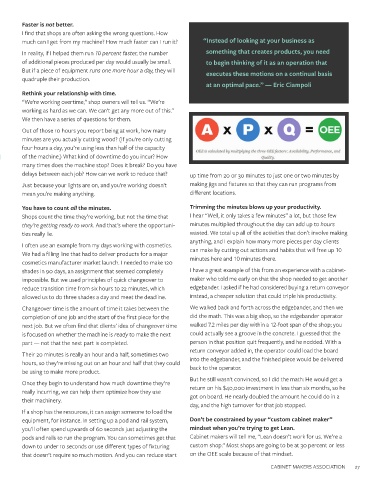
        that doesn’t require so much motion. And you can reduce start   on the OEE scale because of that mindset.

                                                                                         CABINET MAKERS ASSOCIATION   27

