


Page 33 - Program 2018
P. 33
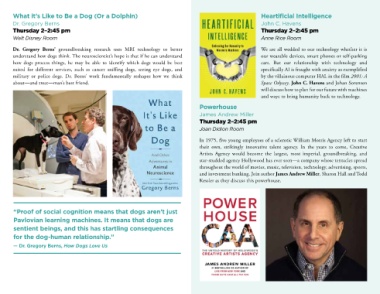
What it’s Like to Be a Dog (Or a Dolphin)                                                               Heartificial Intelligence
      Dr. Gregory Berns                                                                                       John C. Havens
      Thursday 2–2:45 pm                                                                                      Thursday 2–2:45 pm
      Walt Disney Room                                                                                        Anne Rice Room

      Dr. Gregory Berns’ groundbreaking research uses MRI technology to better                                We are all wedded to our technology whether it is
      understand how dogs think. The neuroscientist’s hope is that if he can understand                       our wearable devices, smart phones or self-parking
      how dogs process things, he may be able to identify which dogs would be best                            cars. But our relationship with technology and
      suited for different services, such as cancer sniffing dogs, seeing eye dogs, and                       specifically AI is fraught with anxiety as exemplified
      military or police dogs. Dr. Berns’ work fundamentally reshapes how we think                            by the villainous computer HAL in the film 2001: A
      about—and treat—man’s best friend.                                                                      Space Odyssey. John C. Havens and Johan Sorensen
                                                                                                              will discuss how to plan for our future with machines
                                                                                                              and ways to bring humanity back to technology.

                                                                                    Powerhouse
                                                                                    James Andrew Miller
                                                                                    Thursday 2–2:45 pm
                                                                                    Joan Didion Room

                                                                                    In 1975, five young employees of a sclerotic William Morris Agency left to start
                                                                                    their own, strikingly innovative talent agency. In the years to come, Creative
                                                                                    Artists Agency would become the largest, most imperial, groundbreaking, and
                                                                                    star-studded agency Hollywood has ever seen—a company whose tentacles spread
                                                                                    throughout the world of movies, music, television, technology, advertising, sports,
                                                                                    and investment banking. Join author James Andrew Miller, Sharon Hall and Todd
                                                                                    Kessler as they discuss this powerhouse.


       “Proof of social cognition means that dogs aren’t just
       Pavlovian learning machines. It means that dogs are
       sentient beings, and this has startling consequences

       for the dog-human relationship.”
       — Dr. Gregory Berns, How Dogs Love Us


                                                                                                                                                          32

