


Page 22 - law prep tutorial gk compendium 2021.cdr
P. 22
CLAT 2021                                                                      21 Year Experienced Team


                                          Chauri Chaura Incident

        on the 100th year of the Chauri Chaura event, a postage stamp was released by the Prime Minister.
        About:
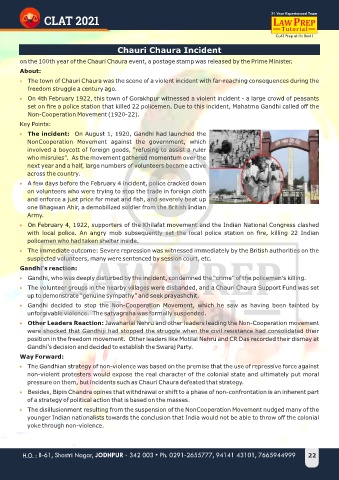
        f  The town of Chauri Chaura was the scene of a violent incident with far-reaching consequences during the
           freedom struggle a century ago.
        f  On 4th February 1922, this town of Gorakhpur witnessed a violent incident - a large crowd of peasants
           set on fire a police station that killed 22 policemen. Due to this incident, Mahatma Gandhi called off the
           Non-Cooperation Movement (1920-22).

        Key Points:
        f  The incident:   On August 1, 1920, Gandhi had launched the
           NonCooperation  Movement  against  the  government,  which
           involved a boycott of foreign goods, “refusing to assist a ruler
           who misrules”.  As the movement gathered momentum over the
           next year and a half, large numbers of volunteers became active
           across the country.
        f  A few days before the February 4 incident, police cracked down
           on volunteers who were trying to stop the trade in foreign cloth
           and enforce a just price for meat and fish, and severely beat up
           one Bhagwan Ahir, a demobilized soldier from the British Indian
           Army.
        f  On February 4, 1922, supporters of the Khilafat movement and the Indian National Congress clashed
           with  local  police.  An  angry  mob  subsequently  set  the  local  police  station  on  fire,  killing  22  Indian
           policemen who had taken shelter inside.
        f  The immediate outcome: Severe repression was witnessed immediately by the British authorities on the
           suspected volunteers, many were sentenced by session court, etc.
        Gandhi's reaction:
        f  Gandhi, who was deeply disturbed by the incident, condemned the “crime” of the policemen's killing.
        f  The volunteer groups in the nearby villages were disbanded, and a Chauri Chaura Support Fund was set
           up to demonstrate “genuine sympathy” and seek prayashchit.
        f  Gandhi  decided  to  stop  the  Non-Cooperation  Movement,  which  he  saw  as  having  been  tainted  by
           unforgivable violence.  The satyagraha was formally suspended.
        f  Other Leaders Reaction: Jawaharlal Nehru and other leaders leading the Non-Cooperation movement
           were shocked that Gandhiji had stopped the struggle when the civil resistance had consolidated their
           position in the freedom movement.  Other leaders like Motilal Nehru and CR Das recorded their dismay at
           Gandhi's decision and decided to establish the Swaraj Party.
        Way Forward:
        f  The Gandhian strategy of non-violence was based on the premise that the use of repressive force against
           non-violent protesters would expose the real character of the colonial state and ultimately put moral
           pressure on them, but incidents such as Chauri Chaura defeated that strategy.
        f  Besides, Bipin Chandra opines that withdrawal or shift to a phase of non-confrontation is an inherent part
           of a strategy of political action that is based on the masses.
        f  The disillusionment resulting from the suspension of the NonCooperation Movement nudged many of the
           younger Indian nationalists towards the conclusion that India would not be able to throw off the colonial
           yoke through non-violence.


         H.O. :                                                                                              22

