


Page 203 - Super Earth Encyclopedia
P. 203
POLAR FRINGE


                                                                    TUNDRA


                                                                 The ice sheets of the Arctic and Antarctic are fringed
                                                                 by bleak, almost treeless tundra. In this region, the Sun
                                                                 barely rises above the horizon in winter, so temperatures
                                                                 plummet and any water in the ground freezes. But when
                                                                 summer arrives, it brings almost constant daylight,
                                                                 warming the ground. The surface layers thaw out and
                                                                 often turn the ground into waterlogged swamps. Tough
                                                                 flowering plants that can survive the winter now bloom and
                                                                 set their seeds, while swarming insects breed in the swamp
                                                                 pools. These plants and insects attract summer visitors such
                                                                 as geese, which nest and raise their young, then fly away to
                                                                 warmer regions as the winter snow starts to fall again.


                                                                     AROUND THE WORLD


                                                                     Most of the world’s tundra lies
                                                                     to the north of the great boreal                ARCTIC
                                                                     forests, all around the Arctic                           ASIA
                                                                     Ocean in Alaska, Canada, coastal    NORTH       EUROPE
                                                                     Greenland, Iceland, Scandinavia,   AMERICA     AFRICA
                                                                     and Russia. It is scattered in the   Equator
                                                                     Southern Hemisphere, occurring         SOUTH             AUSTRALASIA
                                                                     on the fringes of Antarctica and       AMERICA
                                                                     the remote, rocky islands of the
                                                                     icy Southern Ocean.
                                                                                                                     ANTARCTICA


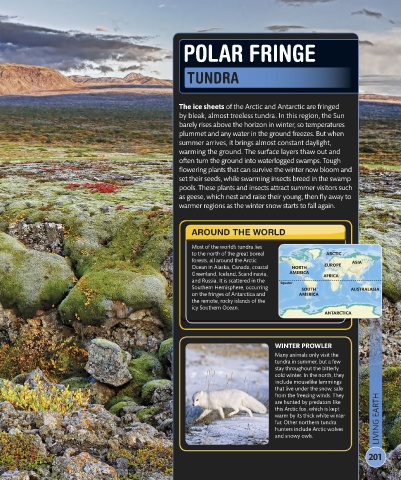
                                                                                                   WINTER PROWLER
                                                                                                   Many animals only visit the
                                                                                                   tundra in summer, but a few
                                                                                                   stay throughout the bitterly
                                                                                                   cold winter. In the north, they
                                                                                                   include mouselike lemmings
                                                                                                   that live under the snow, safe
                                                                                                   from the freezing winds. They
                                                                                                   are hunted by predators like
                                                                                                   this Arctic fox, which is kept
                                                                                                   warm by its thick white winter
                                                                                                   fur. Other northern tundra           LIVING EARTH
                                                                                                   hunters include Arctic wolves
                                                                                                   and snowy owls.


                                                                                                                                    201


   US_200-201_Tundra.indd   201                                                                                                      01/03/17   1:39 pm

