


Page 105 - Euclid's Elements of Geometry
P. 105
ST	EW      gþ.


                                                                                            ELEMENTS BOOK 3


            ἐστὶ τῷ ὑπὸ τῶν τῆς ἑτέρας τμημάτων περιεχομένῳ ὀρθο-  to the (square) on FB. And the (rectangle contained)
            γωνίῳ· ὅπερ ἔδει δεῖξαι.                            by AE and EC plus the (square) on FE was also shown
                                                                (to be) equal to the (square) on FB. Thus, the (rect-
                                                                angle contained) by AE and EC plus the (square) on
                                                                FE is equal to the (rectangle contained) by DE and EB
                                   lþ                          tained by AE and EC is equal to the rectangle contained
                                                                plus the (square) on FE. Let the (square) on FE have
                                                                been taken from both. Thus, the remaining rectangle con-

                                                                by DE and EB.
                                                                   Thus, if two straight-lines in a circle cut one another
                                                                then the rectangle contained by the pieces of one is equal
                                                                to the rectangle contained by the pieces of the other.
                                                                (Which is) the very thing it was required to show.
                                                                                 Proposition 36
                                      .
               ᾿Εὰν κύκλου ληφθῇ τι σημεῖον ἐκτός, καὶ ἀπ᾿ αὐτοῦ   If some point is taken outside a circle, and two
            πρὸς τὸν κύκλον προσπίπτωσι δύο εὐθεῖαι, καὶ ἡ μὲν αὐτῶν straight-lines radiate from it towards the circle, and (one)
            τέμνῃ τὸν κύκλον, ἡ δὲ ἐφάπτηται, ἔσται τὸ ὑπὸ ὅλης τῆς of them cuts the circle, and the (other) touches (it), then
            τεμνούσης καὶ τῆς ἐκτὸς ἀπολαμβανομένης μεταξὺ τοῦ τε  the (rectangle contained) by the whole (straight-line)
            σημείου καὶ τῆς κυρτῆς περιφερείας ἴσον τῷ ἀπὸ τῆς ἐφα- cutting (the circle), and the (part of it) cut off outside
            πτομένης τετραγώνῳ.                                 (the circle), between the point and the convex circumfer-
                                                                ence, will be equal to the square on the tangent (line).
                          Α                                                  A


                                                   Ε                                                   E
              Β         Ζ                                        B         F
                                                           Α                                                   A
                                              Γ                                                  C
                                                     Ζ                                                  F
                    Γ            ∆                 Β                  C              D                 B


               ∆                                                  D
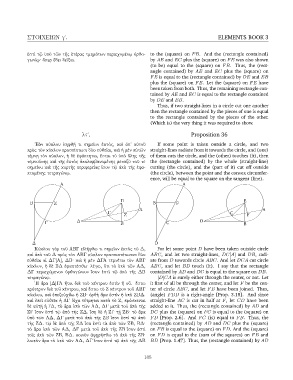
               Κύκλου γὰρ τοῦ ΑΒΓ εἰλήφθω τι σημεῖον ἐκτὸς τὸ Δ,   For let some point D have been taken outside circle
            καὶ ἀπὸ τοῦ Δ πρὸς τὸν ΑΒΓ κύκλον προσπιπτέτωσαν δύο  ABC, and let two straight-lines, DC[A] and DB, radi-
            εὐθεῖαι αἱ ΔΓ[Α], ΔΒ· καὶ ἡ μὲν ΔΓΑ τεμνέτω τὸν ΑΒΓ  ate from D towards circle ABC. And let DCA cut circle
            κύκλον, ἡ δὲ ΒΔ ἐφαπτέσθω· λέγω, ὅτι τὸ ὑπὸ τῶν ΑΔ,  ABC, and let BD touch (it). I say that the rectangle
            ΔΓ περιεχόμενον ὀρθογώνιον ἴσον ἐστὶ τῷ ἀπὸ τῆς ΔΒ  contained by AD and DC is equal to the square on DB.
            τετραγώνῳ.                                             [D]CA is surely either through the center, or not. Let
               ῾Η ἄρα [Δ]ΓΑ ἤτοι διὰ τοῦ κέντρου ἐστὶν ἢ οὔ. ἔστω it first of all be through the center, and let F be the cen-
            πρότερον διὰ τοῦ κέντρου, καὶ ἔστω τὸ Ζ κέντρον τοῦ ΑΒΓ  ter of circle ABC, and let FB have been joined. Thus,
            κύκλου, καὶ ἐπεζεύχθω ἡ ΖΒ· ὀρθὴ ἄρα ἐστὶν ἡ ὑπὸ ΖΒΔ. (angle) FBD is a right-angle [Prop. 3.18]. And since
            καὶ ἐπεὶ εὐθεῖα ἡ ΑΓ δίχα τέτμηται κατὰ τὸ Ζ, πρόσκειται straight-line AC is cut in half at F, let CD have been
            δὲ αὐτῇ ἡ ΓΔ, τὸ ἄρα ὑπὸ τῶν ΑΔ, ΔΓ μετὰ τοῦ ἀπὸ τῆς added to it. Thus, the (rectangle contained) by AD and
            ΖΓ ἴσον ἐστὶ τῷ ἀπὸ τῆς ΖΔ. ἴση δὲ ἡ ΖΓ τῇ ΖΒ· τὸ ἄρα DC plus the (square) on FC is equal to the (square) on
            ὑπὸ τῶν ΑΔ, ΔΓ μετὰ τοῦ ἀπὸ τῆς ΖΒ ἴσον ἐστὶ τῷ ἀπὸ FD [Prop. 2.6]. And FC (is) equal to FB. Thus, the
            τὴς ΖΔ. τῷ δὲ ἀπὸ τῆς ΖΔ ἴσα ἐστὶ τὰ ἀπὸ τῶν ΖΒ, ΒΔ· (rectangle contained) by AD and DC plus the (square)
            τὸ ἄρα ὑπὸ τῶν ΑΔ, ΔΓ μετὰ τοῦ ἀπὸ τῆς ΖΒ ἴσον ἐστὶ  on FB is equal to the (square) on FD. And the (square)
            τοῖς ἀπὸ τῶν ΖΒ, ΒΔ. κοινὸν ἀφῃρήσθω τὸ ἀπὸ τῆς ΖΒ· on FD is equal to the (sum of the squares) on FB and
            λοιπὸν ἄρα τὸ ὑπὸ τῶν ΑΔ, ΔΓ ἴσον ἐστὶ τῷ ἀπὸ τῆς ΔΒ  BD [Prop. 1.47]. Thus, the (rectangle contained) by AD


                                                             105

