


Page 161 - Euclid's Elements of Geometry
P. 161
ST	EW      þ.

                                    eþ                          ing equal angles correspond. (Which is) the very thing it


                                                                                            ELEMENTS BOOK 6


                                                                was required to show.

                                                                                  Proposition 5
                                      .
               ᾿Εὰν δύο τρίγωνα τὰς πλευρὰς ἀνάλογον ἔχῃ, ἰσογώνια  If two triangles have proportional sides then the trian-
            ἔσται τὰ τρίγωνα καὶ ἴσας ἕξει τὰς γωνίας, ὑφ᾿ ἃς αἱ gles will be equiangular, and will have the angles which
            ὁμόλογοι πλευραὶ ὑποτείνουσιν.                      corresponding sides subtend equal.
                                    Α               ∆                                   A               D


                                                     Ζ                                                  F
                                           Ε                                                   E


                                                     Η                                                  G
                                   Γ                                                  C
                   Β                                                   B
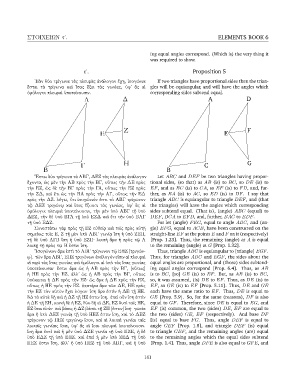
               ῎Εστω δύο τρίγωνα τὰ ΑΒΓ, ΔΕΖ τὰς πλευρὰς ἀνάλογον  Let ABC and DEF be two triangles having propor-
            ἔχοντα, ὡς μὲν τὴν ΑΒ πρὸς τὴν ΒΓ, οὕτως τὴν ΔΕ πρὸς  tional sides, (so that) as AB (is) to BC, so DE (is) to
            τὴν ΕΖ, ὡς δὲ τὴν ΒΓ πρὸς τὴν ΓΑ, οὕτως τὴν ΕΖ πρὸς  EF, and as BC (is) to CA, so EF (is) to FD, and, fur-
            τὴν ΖΔ, καὶ ἔτι ὡς τὴν ΒΑ πρὸς τὴν ΑΓ, οὕτως τὴν ΕΔ  ther, as BA (is) to AC, so ED (is) to DF. I say that
            πρὸς τὴν ΔΖ. λέγω, ὅτι ἰσογώνιόν ἐστι τὸ ΑΒΓ τρίγωνον  triangle ABC is equiangular to triangle DEF, and (that
            τῷ ΔΕΖ τριγώνῳ καὶ ἴσας ἕξουσι τὰς γωνίας, ὑφ᾿ ἃς αἱ the triangles) will have the angles which corresponding
            ὁμόλογοι πλευραὶ ὑποτείνουσιν, τὴν μὲν ὑπὸ ΑΒΓ τῇ ὑπὸ sides subtend equal. (That is), (angle) ABC (equal) to
            ΔΕΖ, τὴν δὲ ὑπὸ ΒΓΑ τῇ ὑπὸ ΕΖΔ καὶ ἔτι τὴν ὑπὸ ΒΑΓ  DEF, BCA to EFD, and, further, BAC to EDF.
            τῇ ὑπὸ ΕΔΖ.                                            For let (angle) FEG, equal to angle ABC, and (an-
               Συνεστάτω γὰρ πρὸς τῇ ΕΖ εὐθείᾳ καὶ τοῖς πρὸς αὐτῇ gle) EFG, equal to ACB, have been constructed on the
            σημείοις τοῖς Ε, Ζ τῇ μὲν ὑπὸ ΑΒΓ γωνίᾳ ἴση ἡ ὑπὸ ΖΕΗ,  straight-line EF at the points E and F on it (respectively)
            τῇ δὲ ὑπὸ ΑΓΒ ἴση ἡ ὑπὸ ΕΖΗ· λοιπὴ ἄρα ἡ πρὸς τῷ Α [Prop. 1.23]. Thus, the remaining (angle) at A is equal
            λοιπῇ τῇ πρὸς τῷ Η ἐστιν ἴση.                       to the remaining (angle) at G [Prop. 1.32].
               ῎Ισογώνιον ἄρα ἐστὶ τὸ ΑΒΓ τρίγωνον τῷ ΕΗΖ [τριγών-  Thus, triangle ABC is equiangular to [triangle] EGF.
            ῳ]. τῶν ἄρα ΑΒΓ, ΕΗΖ τριγώνων ἀνάλογόν εἰσιν αἱ πλευραὶ Thus, for triangles ABC and EGF, the sides about the
            αἱ περὶ τὰς ἴσας γωνίας καὶ ὁμόλογοι αἱ ὑπὸ τὰς ἴσας γωνίας  equal angles are proportional, and (those) sides subtend-
            ὑποτείνουσαι· ἔστιν ἄρα ὡς ἡ ΑΒ πρὸς τὴν ΒΓ, [οὕτως] ing equal angles correspond [Prop. 6.4]. Thus, as AB
            ἡ ΗΕ πρὸς τὴν ΕΖ. ἀλλ᾿ ὡς ἡ ΑΒ πρὸς τὴν ΒΓ, οὕτως is to BC, [so] GE (is) to EF. But, as AB (is) to BC,
            ὑπόκειται ἡ ΔΕ πρὸς τὴν ΕΖ· ὡς ἄρα ἡ ΔΕ πρὸς τὴν ΕΖ, so, it was assumed, (is) DE to EF. Thus, as DE (is) to
            οὕτως ἡ ΗΕ πρὸς τὴν ΕΖ. ἑκατέρα ἄρα τῶν ΔΕ, ΗΕ πρὸς  EF, so GE (is) to EF [Prop. 5.11]. Thus, DE and GE
            τὴν ΕΖ τὸν αὐτὸν ἔχει λόγον· ἴση ἄρα ἐστὶν ἡ ΔΕ τῇ ΗΕ.  each have the same ratio to EF. Thus, DE is equal to
            διὰ τὰ αὐτὰ δὴ καὶ ἡ ΔΖ τῇ ΗΖ ἐστιν ἴση. ἐπεὶ οὖν ἴση ἐστὶν GE [Prop. 5.9]. So, for the same (reasons), DF is also
            ἡ ΔΕ τῇ ΕΗ, κοινὴ δὲ ἡ ΕΖ, δύο δὴ αἱ ΔΕ, ΕΖ δυσὶ ταῖς ΗΕ,  equal to GF. Therefore, since DE is equal to EG, and
            ΕΖ ἴσαι εἰσίν· καὶ βάσις ἡ ΔΖ βάσει τῇ ΖΗ [ἐστιν] ἴση· γωνία  EF (is) common, the two (sides) DE, EF are equal to
            ἄρα ἡ ὑπὸ ΔΕΖ γωνίᾳ τῇ ὑπὸ ΗΕΖ ἐστιν ἴση, καὶ τὸ ΔΕΖ  the two (sides) GE, EF (respectively). And base DF
            τρίγωνον τῷ ΗΕΖ τριγώνῳ ἴσον, καὶ αἱ λοιπαὶ γωνίαι ταῖς [is] equal to base FG. Thus, angle DEF is equal to
            λοιπαῖς γωνίαις ἴσαι, ὑφ᾿ ἃς αἱ ἴσαι πλευραὶ ὑποτείνουσιν. angle GEF [Prop. 1.8], and triangle DEF (is) equal
            ἴση ἄρα ἐστὶ καὶ ἡ μὲν ὑπὸ ΔΖΕ γωνία τῇ ὑπὸ ΗΖΕ, ἡ δὲ  to triangle GEF, and the remaining angles (are) equal
            ὑπὸ ΕΔΖ τῇ ὑπὸ ΕΗΖ. καὶ ἐπεὶ ἡ μὲν ὑπὸ ΖΕΔ τῇ ὑπὸ to the remaining angles which the equal sides subtend
            ΗΕΖ ἐστιν ἴση, ἀλλ᾿ ἡ ὑπὸ ΗΕΖ τῇ ὑπὸ ΑΒΓ, καὶ ἡ ὑπὸ [Prop. 1.4]. Thus, angle DFE is also equal to GFE, and

                                                             161

