


Page 178 - Euclid's Elements of Geometry
P. 178
ST	EW      þ.


                                                                                            ELEMENTS BOOK 6


            πολύγωνον πρὸς τὸ πολύγωνον διπλασίονα λόγον ἔχει ἤπερ to triangle FGL with respect to (that) the corresponding
            ἡ ὁμόλογος πλευρὰ πρὸς τὴν ὁμόλογον πλευράν [ὅπερ ἔδει side AB (has) to the corresponding side FG. For, similar
            δεῖξαι].                                            triangles are in the squared ratio of corresponding sides
                                                                [Prop. 6.14]. Thus, polygon ABCDE also has a squared
                                 ìri  sma                      bers of similar triangles corresponding (in proportion) to
                                                                ratio to polygon FGHKL with respect to (that) the cor-
                                                                responding side AB (has) to the corresponding side FG.
                                                                   Thus, similar polygons can be divided into equal num-


                                                                the wholes, and one polygon has to the (other) polygon a
                                                                squared ratio with respect to (that) a corresponding side
                                                                (has) to a corresponding side. [(Which is) the very thing
                                                                it was required to show].

                                         .
                                                                                    Corollary
                                   kaþ
               ῾Ωσαύτως δὲ καὶ ἐπὶ τῶν [ὁμοίων] τετραπλεύρων δειχθή-  And, in the same manner, it can also be shown for
            σεται, ὅτι ἐν διπλασίονι λόγῳ εἰσὶ τῶν ὁμολόγων πλευρῶν. [similar] quadrilaterals that they are in the squared ratio
            ἐδείχθη δὲ καὶ ἐπὶ τῶν τριγώνων· ὥστε καὶ καθόλου τὰ  of (their) corresponding sides. And it was also shown for
            ὅμοια εὐθύγραμμα σχήματα πρὸς ἄλληλα ἐν διπλασίονι triangles. Hence, in general, similar rectilinear figures are
            λόγῳ εἰσὶ τῶν ὁμολόγων πλευρῶν. ὅπερ ἔδει δεῖξαι.   also to one another in the squared ratio of (their) corre-
                                                                sponding sides. (Which is) the very thing it was required
                                                                to show.

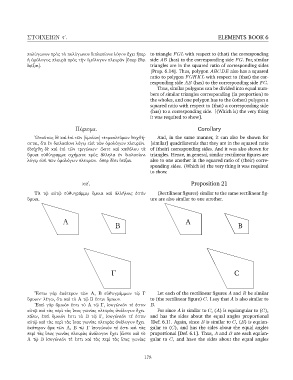
                                                                                 Proposition 21
                                      .
               Τὰ τῷ αὐτῷ εὐθυγράμμῳ ὅμοια καὶ ἀλλήλοις ἐστὶν      (Rectilinear figures) similar to the same rectilinear fig-
            ὅμοια.                                              ure are also similar to one another.


                           Α                                                   A
                                                 Β                                                   B


                                                Γ                                                  C


               ῎Εστω γὰρ ἑκάτερον τῶν Α, Β εὐθυγράμμων τῷ Γ        Let each of the rectilinear figures A and B be similar
            ὅμοιον· λέγω, ὅτι καὶ τὸ Α τῷ Β ἐστιν ὅμοιον.       to (the rectilinear figure) C. I say that A is also similar to
               ᾿Επεὶ γὰρ ὅμοιόν ἐστι τὸ Α τῷ Γ, ἰσογώνιόν τέ ἐστιν B.
            αὐτῷ καὶ τὰς περὶ τὰς ἴσας γωνίας πλευρὰς ἀνάλογον ἔχει.  For since A is similar to C, (A) is equiangular to (C),
            πάλιν, ἐπεὶ ὅμοιόν ἐστι τὸ Β τῷ Γ, ἰσογώνιόν τέ ἐστιν and has the sides about the equal angles proportional
            αὐτῷ καὶ τὰς περὶ τὰς ἴσας γωνίας πλευρὰς ἀνάλογον ἔχει. [Def. 6.1]. Again, since B is similar to C, (B) is equian-
            ἑκάτερον ἄρα τῶν Α, Β τῷ Γ ἰσογώνιόν τέ ἐστι καὶ τὰς gular to (C), and has the sides about the equal angles
            περὶ τὰς ἴσας γωνίας πλευρὰς ἀνάλογον ἔχει [ὥστε καὶ τὸ  proportional [Def. 6.1]. Thus, A and B are each equian-
            Α τῷ Β ἰσογώνιόν τέ ἐστι καὶ τὰς περὶ τὰς ἴσας γωνίας  gular to C, and have the sides about the equal angles


                                                             178

