


Page 208 - Euclid's Elements of Geometry
P. 208
ST	EW      zþ.      iþ                                                     ELEMENTS BOOK 7


                                                                                                †
                                                                                Proposition 16
                                      .
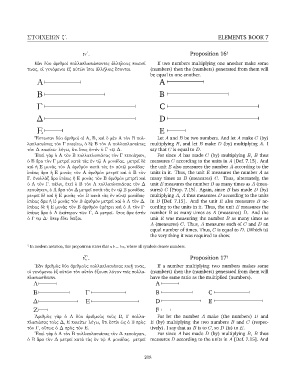
               Εὰν δύο ἀριθμοὶ πολλαπλασιάσαντες ἀλλήλους ποιῶσί   If two numbers multiplying one another make some
            τινας, οἱ γενόμενοι ἐξ αὐτῶν ἴσοι ἀλλήλοις ἔσονται.  (numbers) then the (numbers) generated from them will
                                                                be equal to one another.
                Α                                                   A


                Β                                                   B

                Γ                                                   C

                ∆                                                   D

                Ε                                                   E
               ῎Εστωσαν δύο ἀριθμοὶ οἱ Α, Β, καὶ ὁ μὲν Α τὸν Β πολ-  Let A and B be two numbers. And let A make C (by)
            λαπλασιάσας τὸν Γ ποιείτω, ὁ δὲ Β τὸν Α πολλαπλασιάσας multiplying B, and let B make D (by) multiplying A. I
            τὸν Δ ποιείτω· λέγω, ὅτι ἴσος ἐστὶν ὁ Γ τῷ Δ.       say that C is equal to D.
               ᾿Επεὶ γὰρ ὁ Α τὸν Β πολλαπλασιάσας τὸν Γ πεποίηκεν,  For since A has made C (by) multiplying B, B thus
            ὁ Β ἄρα τὸν Γ μετρεῖ κατὰ τὰς ἐν τῷ Α μονάδας. μετρεῖ δὲ  measures C according to the units in A [Def. 7.15]. And
            καὶ ἡ Ε μονὰς τὸν Α ἀριθμὸν κατὰ τὰς ἐν αὐτῷ μονάδας· the unit E also measures the number A according to the
            ἰσάκις ἄρα ἡ Ε μονὰς τὸν Α ἀριθμὸν μετρεῖ καὶ ὁ Β τὸν units in it. Thus, the unit E measures the number A as
            Γ. ἐναλλὰξ ἄρα ἰσάκις ἡ Ε μονὰς τὸν Β ἀριθμὸν μετρεῖ καὶ many times as B (measures) C. Thus, alternately, the
            ὁ Α τὸν Γ. πάλιν, ἐπεὶ ὁ Β τὸν Α πολλαπλασιάσας τὸν Δ unit E measures the number B as many times as A (mea-
            πεποίηκεν, ὁ Α ἄρα τὸν Δ μετρεῖ κατὰ τὰς ἐν τῷ Β μονάδας. sures) C [Prop. 7.15]. Again, since B has made D (by)
            μετρεῖ δὲ καὶ ἡ Ε μονὰς τὸν Β κατὰ τὰς ἐν αὐτῷ μονάδας· multiplying A, A thus measures D according to the units
            ἰσάκις ἄρα ἡ Ε μονὰς τὸν Β ἀριθμὸν μετρεῖ καὶ ὁ Α τὸν Δ. in B [Def. 7.15]. And the unit E also measures B ac-
                                    izþ                         equal number of times. Thus, C is equal to D. (Which is)
            ἰσάκις δὲ ἡ Ε μονὰς τὸν Β ἀριθμὸν ἐμέτρει καὶ ὁ Α τὸν Γ· cording to the units in it. Thus, the unit E measures the
            ἰσάκις ἄρα ὁ Α ἑκάτερον τῶν Γ, Δ μετρεῖ. ἴσος ἄρα ἐστὶν number B as many times as A (measures) D. And the
            ὁ Γ τῷ Δ· ὅπερ ἔδει δεῖξαι.                         unit E was measuring the number B as many times as
                                                                A (measures) C. Thus, A measures each of C and D an

                                                                the very thing it was required to show.

            †  In modern notation, this proposition states that a b = b a, where all symbols denote numbers.
                                                                                Proposition 17
                                                                                                †
                                      .
               ᾿Εὰν ἀριθμὸς δύο ἀριθμοὺς πολλαπλασιάσας ποιῇ τινας,  If a number multiplying two numbers makes some
            οἱ γενόμενοι ἐξ αὐτῶν τὸν αὐτὸν ἕξουσι λόγον τοῖς πολλα- (numbers) then the (numbers) generated from them will
            πλασιασθεῖσιν.                                      have the same ratio as the multiplied (numbers).
               Α                                                  A

               Β                     Γ                            B                     C
               ∆                     Ε                            D                     E
               Ζ                                                  F
               ᾿Αριθμὸς γὰρ ὁ Α δύο ἀριθμοὺς τοὺς Β, Γ πολλα-      For let the number A make (the numbers) D and
            πλασιάσας τοὺς Δ, Ε ποιείτω· λέγω, ὅτι ἐστὶν ὡς ὁ Β πρὸς  E (by) multiplying the two numbers B and C (respec-
            τὸν Γ, οὕτως ὁ Δ πρὸς τὸν Ε.                        tively). I say that as B is to C, so D (is) to E.
               ᾿Επεὶ γὰρ ὁ Α τὸν Β πολλαπλασιάσας τὸν Δ πεποίηκεν,  For since A has made D (by) multiplying B, B thus
            ὁ Β ἄρα τὸν Δ μετρεῖ κατὰ τὰς ἐν τῷ Α μονάδας. μετρεῖ  measures D according to the units in A [Def. 7.15]. And


                                                             208

