


Page 54 - Euclid's Elements of Geometry
P. 54
ST	EW      bþ.


                                                                                            ELEMENTS BOOK 2


            ὅλης τετράγωνον ἴσον ἐστὶ τοῖς τε ἀπὸ τῶν τμημάτων τε- AC and BC, and twice the rectangle contained by AC
            τραγώνοις καὶ τῷ δὶς ὑπὸ τῶν τμημάτων περιεχομένῳ ὀρθο-  and CB. But, the (figures) HF, CK, AG, and GE are
            γωνίῳ· ὅπερ ἔδει δεῖξαι.                            (equivalent to) the whole of ADEB, which is the square
                                                                on AB. Thus, the square on AB is equal to the (sum
                                                                of the) squares on AC and CB, and twice the rectangle
                                    eþ                          square on the whole (straight-line) is equal to the (sum
                                                                contained by AC and CB.
                                                                   Thus, if a straight-line is cut at random then the

                                                                of the) squares on the pieces (of the straight-line), and
                                                                twice the rectangle contained by the pieces. (Which is)
                                                                the very thing it was required to show.

                                                                2
                                                                       2
            †  This proposition is a geometric version of the algebraic identity: (a + b) = a + b + 2 a b.
                                                                    2
                                      .
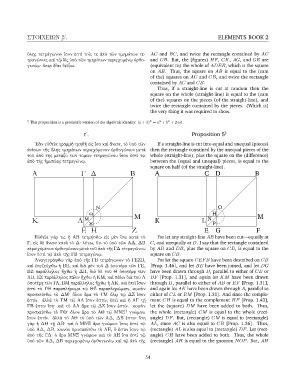
                                                                                 Proposition 5
                                                                                               ‡
               ᾿Εὰν εὐθεῖα γραμμὴ τμηθῇ εἰς ἴσα καὶ ἄνισα, τὸ ὑπὸ τῶν  If a straight-line is cut into equal and unequal (pieces)
            ἀνίσων τῆς ὅλης τμημάτων περιεχόμενον ὀρθογώνιον μετὰ then the rectangle contained by the unequal pieces of the
            τοῦ ἀπὸ τῆς μεταξὺ τῶν τομῶν τετραγώνου ἴσον ἐστὶ τῷ whole (straight-line), plus the square on the (difference)
            ἀπὸ τῆς ἡμισείας τετραγώνῳ.                         between the (equal and unequal) pieces, is equal to the
                                                                square on half (of the straight-line).
              Α                    Γ ∆                  Β         A                   C D                   B


                                         Ν                                                  O
                                      Θ                  Μ                                H                  M
              Κ                  Λ  Μ                             K                  L  N
                                      Ξ                                                   P
                                   Ε Η                  Ζ                             E    G                F
               Εὐθεῖα γάρ τις ἡ ΑΒ τετμήσθω εἰς μὲν ἴσα κατὰ τὸ    For let any straight-line AB have been cut—equally at
            Γ, εἰς δὲ ἄνισα κατὰ τὸ Δ· λέγω, ὅτι τὸ ὑπὸ τῶν ΑΔ, ΔΒ  C, and unequally at D. I say that the rectangle contained
            περιεχόμενον ὀρθογώνιον μετὰ τοῦ ἀπὸ τῆς ΓΔ τετραγώνου  by AD and DB, plus the square on CD, is equal to the
            ἴσον ἐστὶ τῷ ἀπὸ τῆς ΓΒ τετραγώνῳ.                  square on CB.
               ᾿Αναγεγράφθω γὰρ ἀπὸ τῆς ΓΒ τετράγωνον τὸ ΓΕΖΒ,     For let the square CEFB have been described on CB
            καὶ ἐπεζεύχθω ἡ ΒΕ, καὶ διὰ μὲν τοῦ Δ ὁποτέρᾳ τῶν ΓΕ, [Prop. 1.46], and let BE have been joined, and let DG
            ΒΖ παράλληλος ἤχθω ἡ ΔΗ, διὰ δὲ τοῦ Θ ὁποτέρᾳ τῶν   have been drawn through D, parallel to either of CE or
            ΑΒ, ΕΖ παράλληλος πάλιν ἤχθω ἡ ΚΜ, καὶ πάλιν διὰ τοῦ Α BF [Prop. 1.31], and again let KM have been drawn
            ὁποτέρᾳ τῶν ΓΛ, ΒΜ παράλληλος ἤχθω ἡ ΑΚ. καὶ ἐπεὶ ἴσον through H, parallel to either of AB or EF [Prop. 1.31],
            ἐστὶ τὸ ΓΘ παραπλήρωμα τῷ ΘΖ παραπληρώματι, κοινὸν and again let AK have been drawn through A, parallel to
            προσκείσθω τὸ ΔΜ· ὅλον ἄρα τὸ ΓΜ ὅλῳ τῷ ΔΖ ἴσον either of CL or BM [Prop. 1.31]. And since the comple-
            ἐστίν. ἀλλὰ τὸ ΓΜ τῷ ΑΛ ἴσον ἐστίν, ἐπεὶ καὶ ἡ ΑΓ τῇ  ment CH is equal to the complement HF [Prop. 1.43],
            ΓΒ ἐστιν ἴση· καὶ τὸ ΑΛ ἄρα τῷ ΔΖ ἴσον ἐστίν. κοινὸν let the (square) DM have been added to both. Thus,
                                                     †
            προσκείσθω τὸ ΓΘ· ὅλον ἄρα τὸ ΑΘ τῷ ΜΝΞ γνώμονι     the whole (rectangle) CM is equal to the whole (rect-
            ἴσον ἐστίν. ἀλλὰ τὸ ΑΘ τὸ ὑπὸ τῶν ΑΔ, ΔΒ ἐστιν· ἴση angle) DF. But, (rectangle) CM is equal to (rectangle)
            γὰρ ἡ ΔΘ τῇ ΔΒ· καὶ ὁ ΜΝΞ ἄρα γνώμων ἴσος ἐστὶ τῷ AL, since AC is also equal to CB [Prop. 1.36]. Thus,
            ὑπὸ ΑΔ, ΔΒ. κοινὸν προσκείσθω τὸ ΛΗ, ὅ ἐστιν ἴσον τῷ (rectangle) AL is also equal to (rectangle) DF. Let (rect-
            ἀπὸ τῆς ΓΔ· ὁ ἄρα ΜΝΞ γνώμων καὶ τὸ ΛΗ ἴσα ἐστὶ τῷ angle) CH have been added to both. Thus, the whole
            ὑπὸ τῶν ΑΔ, ΔΒ περιεχομένῳ ὀρθογωνίῳ καὶ τῷ ἀπὸ τῆς (rectangle) AH is equal to the gnomon NOP. But, AH


                                                              54

