


Page 73 - Euclid's Elements of Geometry
P. 73
ST	EW      gþ.


                                                                                            ELEMENTS BOOK 3


                                                                (straight-line) CD, which is through the center and cuts
                                                                in half the (straight-line) AB, which is not through the
                                                                center, also cuts (AB) at right-angles.
                                    Γ                                                  C


                                     Ε                                                  E


                      Α                           Β                       A                          B
                                      Ζ                                                  F


                                    ∆                                                  D
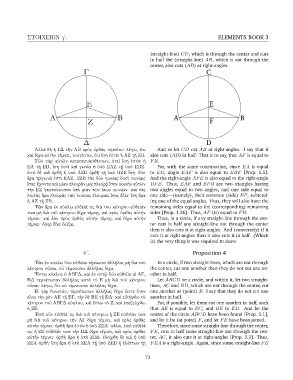
               ᾿Αλλὰ δὴ ἡ ΓΔ τὴν ΑΒ πρὸς ὀρθὰς τεμνέτω· λέγω, ὅτι  And so let CD cut AB at right-angles. I say that it
            καὶ δίχα αὐτὴν τέμνει, τουτέστιν, ὅτι ἴση ἐστὶν ἡ ΑΖ τῇ ΖΒ. also cuts (AB) in half. That is to say, that AF is equal to
               Τῶν γὰρ αὐτῶν κατασκευασθέντων, ἐπεὶ ἴση ἐστὶν ἡ  FB.
            ΕΑ τῇ ΕΒ, ἴση ἐστὶ καὶ γωνία ἡ ὑπὸ ΕΑΖ τῇ ὑπὸ ΕΒΖ.     For, with the same construction, since EA is equal
            ἐστὶ δὲ καὶ ὀρθὴ ἡ ὑπὸ ΑΖΕ ὀρθῇ τῇ ὑπὸ ΒΖΕ ἴση· δύο  to EB, angle EAF is also equal to EBF [Prop. 1.5].
            ἄρα τρίγωνά ἐστι ΕΑΖ, ΕΖΒ τὰς δύο γωνίας δυσὶ γωνίαις And the right-angle AFE is also equal to the right-angle
            ἴσας ἔχοντα καὶ μίαν πλευρὰν μιᾷ πλευρᾷ ἴσην κοινὴν αὐτῶν BFE. Thus, EAF and EFB are two triangles having
            τὴν ΕΖ ὑποτείνουσαν ὑπὸ μίαν τῶν ἴσων γωνιῶν· καὶ τὰς two angles equal to two angles, and one side equal to
            λοιπὰς ἄρα πλευρὰς ταῖς λοιπαῖς πλευραῖς ἴσας ἕξει· ἴση ἄρα one side—(namely), their common (side) EF, subtend-
                                    dþ                          then it also cuts it at right-angles. And (conversely) if it
            ἡ ΑΖ τῇ ΖΒ.                                         ing one of the equal angles. Thus, they will also have the
               ᾿Εὰν ἄρα ἐν κύκλῳ εὐθεῖά τις διὰ τοῦ κέντρου εὐθεῖάν remaining sides equal to the (corresponding) remaining
            τινα μὴ διὰ τοῦ κέντρου δίχα τέμνῃ, καὶ πρὸς ὀρθὰς αὐτὴν sides [Prop. 1.26]. Thus, AF (is) equal to FB.
            τέμνει· καὶ ἐὰν πρὸς ὀρθὰς αὐτὴν τέμνῃ, καὶ δίχα αὐτὴν  Thus, in a circle, if any straight-line through the cen-
            τέμνει· ὅπερ ἔδει δεῖξαι.                           ter cuts in half any straight-line not through the center

                                                                cuts it at right-angles then it also cuts it in half. (Which
                                                                is) the very thing it was required to show.

                                      .
                                                                                  Proposition 4
               ᾿Εὰν ἐν κύκλῳ δύο εὐθεῖαι τέμνωσιν ἀλλήλας μὴ δὶα τοῦ  In a circle, if two straight-lines, which are not through
            κέντρου οὖσαι, οὐ τέμνουσιν ἀλλήλας δίχα.           the center, cut one another then they do not cut one an-
               ῎Εστω κύκλος ὁ ΑΒΓΔ, καὶ ἐν αὐτῷ δύο εὐθεῖαι αἱ ΑΓ, other in half.
            ΒΔ τεμνέτωσαν ἀλλήλας κατὰ τὸ Ε μὴ διὰ τοῦ κέντρου     Let ABCD be a circle, and within it, let two straight-
            οὖσαι· λέγω, ὅτι οὐ τέμνουσιν ἀλλήλας δίχα.         lines, AC and BD, which are not through the center, cut
               Εἰ γὰρ δυνατόν, τεμνέτωσαν ἀλλήλας δίχα ὥστε ἴσην one another at (point) E. I say that they do not cut one
            εἶναι τὴν μὲν ΑΕ τῇ ΕΓ, τὴν δὲ ΒΕ τῇ ΕΔ· καὶ εἰλήφθω τὸ  another in half.
            κέντρον τοῦ ΑΒΓΔ κύκλου, καὶ ἔστω τὸ Ζ, καὶ ἐπεζεύχθω  For, if possible, let them cut one another in half, such
            ἡ ΖΕ.                                               that AE is equal to EC, and BE to ED. And let the
               ᾿Επεὶ οὖν εὐθεῖά τις διὰ τοῦ κέντρου ἡ ΖΕ εὐθεῖάν τινα  center of the circle ABCD have been found [Prop. 3.1],
            μὴ διὰ τοῦ κέντρου τὴν ΑΓ δίχα τέμνει, καὶ πρὸς ὀρθὰς  and let it be (at point) F, and let FE have been joined.
            αὐτὴν τέμνει· ὀρθὴ ἄρα ἐστὶν ἡ ὑπὸ ΖΕΑ· πάλιν, ἐπεὶ εὐθεῖά  Therefore, since some straight-line through the center,
            τις ἡ ΖΕ εὐθεῖάν τινα τὴν ΒΔ δίχα τέμνει, καὶ πρὸς ὀρθὰς  FE, cuts in half some straight-line not through the cen-
            αὐτὴν τέμνει· ὀρθὴ ἄρα ἡ ὑπὸ ΖΕΒ. ἐδείχθη δὲ καὶ ἡ ὑπὸ ter, AC, it also cuts it at right-angles [Prop. 3.3]. Thus,
            ΖΕΑ ὀρθή· ἴση ἄρα ἡ ὑπὸ ΖΕΑ τῇ ὑπὸ ΖΕΒ ἡ ἐλάττων τῇ  FEA is a right-angle. Again, since some straight-line FE

                                                              73

