


Page 43 - Jolliffe I. Principal Component Analysis
P. 43
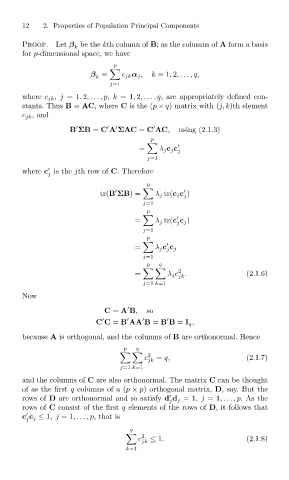
2. Properties of Population Principal Components
                              12
                              Proof. Let β be the kth column of B; as the columns of A form a basis
                                           k
                              for p-dimensional space, we have
                                                      p

                                                β =     c jk α j ,  k =1, 2,... ,q,
                                                 k
                                                     j=1
                              where c jk ,j =1, 2,... ,p, k =1, 2,... ,q, are appropriately defined con-
                              stants. Thus B = AC, where C is the (p × q) matrix with (j, k)th element
                              c jk ,and
                                          B ΣB = C A ΣAC = C ΛC,       using (2.1.3)


                                                                p

                                                            =     λ j c j c
                                                                       j
                                                               j=1
                              where c is the jth row of C. Therefore

                                     j
                                                              p


                                                  tr(B ΣB)=      λ j tr(c j c )

                                                                        j
                                                              j=1
                                                              p

                                                           =     λ j tr(c c j )

                                                                      j
                                                              j=1
                                                              p

                                                           =
                                                                 λ j c c j
                                                                    j
                                                              j=1
                                                              p   q
                                                                       2
                                                           =        λ j c .              (2.1.6)
                                                                       jk
                                                              j=1 k=1
                              Now

                                                   C = A B,   so

                                                 C C = B AA B = B B = I q ,


                              because A is orthogonal, and the columns of B are orthonormal. Hence
                                                        p   q
                                                               2
                                                              c  = q,                    (2.1.7)
                                                               jk
                                                       j=1 k=1
                              and the columns of C are also orthonormal. The matrix C can be thought
                              of as the first q columns of a (p × p) orthogonal matrix, D,say.But the

                              rows of D are orthonormal and so satisfy d d j =1,j =1,...,p.Asthe
                                                                    j
                              rows of C consist of the first q elements of the rows of D, it follows that

                              c c j ≤ 1,j =1,...,p, that is
                               j
                                                          q
                                                             2
                                                            c  ≤ 1.                      (2.1.8)
                                                             jk
                                                         k=1

