


Page 439 - Jolliffe I. Principal Component Analysis
P. 439
14. Generalizations and Adaptations of Principal Component Analysis
                              404
                                               x j ) into parts due to each component. In this respect

                              compose var(
                                           p
                                           j=1
                              there are similarities with a method proposed by Vermeiren et al. (2001),
                              which they call extended principal component analysis. This also decom-

                              poses var(  p  x j ), but does so with rescaled PCs. Denote the kth such
                                         j=1

                              component by z E  = a x, where a E  = c k a k , a k is the usual vector of
                                                  E
                                            k     k           k

                              coefficients for the kth PC with a a k =1, and c k is a rescaling constant.
                                                            k

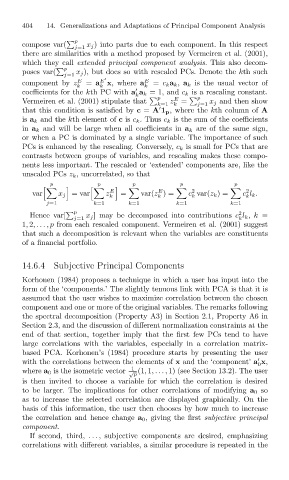
                              Vermeiren et al. (2001) stipulate that  p  z E  =  p j=1  x j and then show
                                                                 k=1 k
                              that this condition is satisfied by c = A 1 p , where the kth column of A

                              is a k and the kth element of c is c k .Thus c k is the sum of the coefficients
                              in a k and will be large when all coefficients in a k are of the same sign,
                              or when a PC is dominated by a single variable. The importance of such
                              PCs is enhanced by the rescaling. Conversely, c k is small for PCs that are
                              contrasts between groups of variables, and rescaling makes these compo-
                              nents less important. The rescaled or ‘extended’ components are, like the
                              unscaled PCs z k , uncorrelated, so that
                                   & p   '      & p   '    p           p             p
                                                                          2              2
                                var    x j =var     z  E  =  var(z )=    c var(z k )=   c l k .
                                                                 E
                                                     k           k        k              k
                                    j=1          k=1      k=1         k=1           k=1
                                                                                       2
                                Hence var[  p  x j ] may be decomposed into contributions c l k ,k =
                                           j=1                                         k
                              1, 2,... ,p from each rescaled component. Vermeiren et al. (2001) suggest
                              that such a decomposition is relevant when the variables are constituents
                              of a financial portfolio.
                              14.6.4 Subjective Principal Components
                              Korhonen (1984) proposes a technique in which a user has input into the
                              form of the ‘components.’ The slightly tenuous link with PCA is that it is
                              assumed that the user wishes to maximize correlation between the chosen
                              component and one or more of the original variables. The remarks following
                              the spectral decomposition (Property A3) in Section 2.1, Property A6 in
                              Section 2.3, and the discussion of different normalization constraints at the
                              end of that section, together imply that the first few PCs tend to have
                              large correlations with the variables, especially in a correlation matrix-
                              based PCA. Korhonen’s (1984) procedure starts by presenting the user
                              with the correlations between the elements of x and the ‘component’ a x,

                                                                                            0
                                                          1
                              where a 0 is the isometric vector √ (1, 1,... , 1) (see Section 13.2). The user
                                                           p
                              is then invited to choose a variable for which the correlation is desired
                              to be larger. The implications for other correlations of modifying a 0 so
                              as to increase the selected correlation are displayed graphically. On the
                              basis of this information, the user then chooses by how much to increase
                              the correlation and hence change a 0 , giving the first subjective principal
                              component.
                                If second, third, ..., subjective components are desired, emphasizing
                              correlations with different variables, a similar procedure is repeated in the

