


Page 66 - Jolliffe I. Principal Component Analysis
P. 66
35
                                        3.2. Geometric Properties of Sample Principal Components


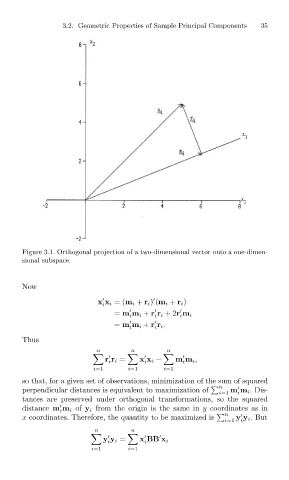
                              Figure 3.1. Orthogonal projection of a two-dimensional vector onto a one-dimen-
                              sional subspace.


                              Now


                                                  x x i =(m i + r i ) (m i + r i )
                                                   i

                                                      = m m i + r r i +2r m i
                                                          i      i     i


                                                      = m m i + r r i .
                                                          i      i
                              Thus
                                                 n        n         n


                                                    r r i =  x x i −  m m i ,
                                                    i         i         i
                                                i=1       i=1      i=1
                              so that, for a given set of observations, minimization of the sum of squared
                              perpendicular distances is equivalent to maximization of    n  m m i .Dis-

                                                                                 i=1  i
                              tances are preserved under orthogonal transformations, so the squared
                              distance m m i of y i from the origin is the same in y coordinates as in

                                        i

                              x coordinates. Therefore, the quantity to be maximized is  n  y y i . But

                                                                                   i=1  i
                                                 n        n


                                                   y y i =
                                                    i        x BB x i
                                                              i
                                                i=1       i=1

