


Page 13 - NCBWJourney.15
P. 13
PHASE THREE 2012 - 2016 13

In December 2012, Forsyth Tech,
   home of the National Center for
the Biotechnology Workforce, an
affiliate of BioNetwork, was award-
ed a three-year, $15 million grant
through the DOL’s Trade Adjust-
ment Assistance Community Col-
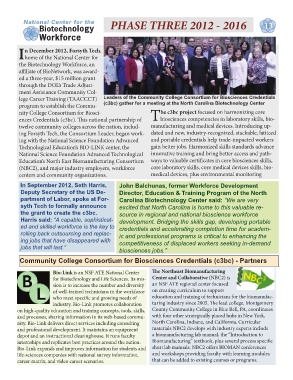
lege Career Training (TAACCCT) Leaders of the Community College Consortium for Biosciences Credentials
Tprogram to establish the Commu- (c3bc) gather for a meeting at the North Carolina Biotechnology Center
nity College Consortium for Biosci-                                he c3bc project focused on harmonizing core
ences Credentials (c3bc). This national partnership of             biosciences competencies in laboratory skills, bio-
twelve community colleges across the nation, includ- manufacturing and medical devices. Introducing up-
ing Forsyth Tech, the Consortium Leader, began work- dated and new, industry-recognized, stackable, latticed
ing with the National Science Foundation Advanced and portable credentials help trade-impacted workers
Technological Education’s BIO-LINK center, the                     gain better jobs. Harmonized skills standards advance
National Science Foundation Advanced Technological innovative training and bring better access and path-
Education’s North East Biomanufacturing Consortium ways to valuable certificates in core biosciences skills,
(NBC2), and major industry employers, workforce                    core laboratory skills, core medical devices skills, bio-
centers and community organizations.                               medical devices, plus environmental monitoring

In September 2012, Seth Harris, John Balchunas, former Workforce Development
Deputy Secretary of the US De- Director, Education & Training Program of the North
partment of Labor, spoke at For- Carolina Biotechnology Center said: “We are very
syth Tech to formally announce excited that North Carolina is home to this valuable re-
the grant to create the c3bc.           source in regional and national bioscience workforce
Harris said: “A capable, sophisticat-   development. Bridging the skills gap, developing portable
ed and skilled workforce is the key to  credentials and accelerating completion time for academ-
rolling back outsourcing and replac-    ic and professional programs is critical to enhancing the
ing jobs that have disappeared with     competitiveness of displaced workers seeking in-demand
jobs that will last.”                   biosciences jobs.”

Community College Consortium for Biosciences Credentials (c3bc) - Partners

                    Bio-Link is an NSF ATE National Center         The Northeast Biomanufacturing
                    for Biotechnology and Life Sciences. Its mis-  Center and Collaborative (NBC2) is
                    sion is to increase the number and diversity   an NSF ATE regional center focused
                    of well-trained technicians in the workforce   on creating curriculum to support
                    who meet specific and growing needs of         education and training of technicians for the biomanufac-
                    industry. Bio-Link promotes collaboration      turing industry since 2005. The lead college, Montgomery
on high-quality education and training concepts, tools, skills,    County Community College in Blue Bell, PA, coordinates
and processes, sharing information in its web-based commu-         with four other strategically placed hubs in New York,
nity. Bio-Link delivers direct services including consulting       North Carolina, Indiana, and California. Curricular
and professional development. It maintains an equipment            materials NBC2 develops with industry experts include
depot and an instructional clearinghouse. It runs faculty          a biomanufacturing lab manual, the “Introduction to
internships and replicates best practices around the nation.       Biomanufacturing” textbook, plus several process specific
Bio-Link expands and improves information for students and         short lab manuals. NBC2 offers BIOMAN conferences
life-sciences companies with national survey information,          and workshops providing faculty with learning modules
career matrix, and video career scenarios.                         that can be added to existing courses or programs.

