


Page 36 - SOA 108
P. 36
Atlantic Crossing


         $ 100 instead of $ 1000 as we had requested. The problem was corrected,
         and we could further receive the files.
         On December 13th, the wind was still strong but with less gusts.  We were
         having  fun  with  the  ARC  weather  forecast  announcing  a  rough  sea
         and  enhanced  trade winds: yes it was blowing hard! Indeed, the wind was
         increasing and would remain on average around 25 knots until arrival.  We
         were making good progress now, almost 125 miles/day every day.
         We were approaching   And around 8h UTC, a    the area where the dis-
         masted mini was drift-                        ing,  its  beacon  having
         stopped four days ago   big surge filled the   we  were  no  longer
         knowing    where   it  cockpit like a bathtub:   could  be,  but  we  were
         South of its last known                       position,  and  it  was
         drifting Southwest. So that we might have found it on our track, and per-
         haps at night! I made several estimates of its possible positions, transferred
         this into the plotter, and we decided to round all these points, what forced
         us to go up a little bit to the North. This diversion cost us some time, but it
         was more cautious.

         At noon on the 16th, we were more than 400 miles from Rodney Bay, and
         Lubilu III 30 miles ahead of us. At the end of the night the wind reached
                              almost 30 knots, we made peak speed at more than
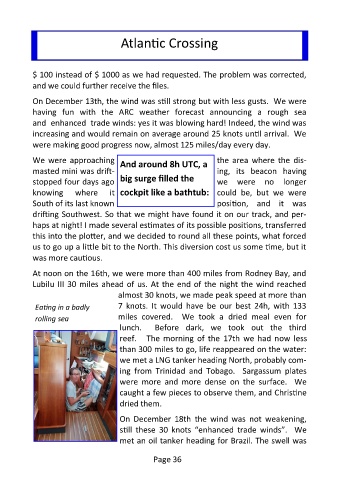
          Eating in a badly    7  knots.  It  would  have  be  our  best  24h,  with  133
          rolling sea         miles  covered.    We  took  a  dried  meal  even  for
                               lunch.    Before  dark,  we  took  out  the  third
                               reef.   The morning of the 17th we had now less
                               than 300 miles to go, life reappeared on the water:
                               we met a LNG tanker heading North, probably com-
                               ing  from  Trinidad  and  Tobago.    Sargassum  plates
                               were  more  and  more  dense  on  the  surface.    We
                               caught a few pieces to observe them, and Christine
                               dried them.
                               On  December  18th  the  wind  was  not  weakening,
                               still  these  30  knots  “enhanced  trade  winds”.    We
                               met an oil tanker heading for Brazil. The swell was

                                       Page 36

