


Page 157 - ...........
P. 157
In addition to the artists who continue to  practice traditional
            Nepali art, there is a large presence of artists who also practice
            nlodern and post-1nodern arts.

            10.3  Fundamentals of Art

            To cornplete a task, we must follow certain rules. Any practice
            that follows  the  rules  ensures  success.  Creating artwork also
            requires following certain rules. These are called fundamentals
            of art.  Con1position harmony,  balance, rhythn1,  proportion,
                                      1
            perspective, and foreshortening are son1e of these fundarnentals.
            Understanding these  fundan1entals  allows  one  to  achieve
            effective and attractive works of art. Among these fundamentals,
            we shall study balance, proportion, and con1position.

            Balance
            One of the fundamental principles in art is balance. The painting
            seen1s stable and gives a feeling of correctness. When there is an
            imbalance, it can rnake the viewer feel uncomfortable. Balance
            n1eans how  line, shape, color, forrn, and texture are related in
            the con1position to create a visual balance by their visual weight.
            It n1eans that one side does not appear to be weightier than the
            other. Artists need to depend on the visual weight of the elements
            in the composition to decide if a piece is balanced.

            There are two types of balance in arts.

            a.    Formal or syn1metrical balance

            b.    Infonnal or asyn1metrical balance

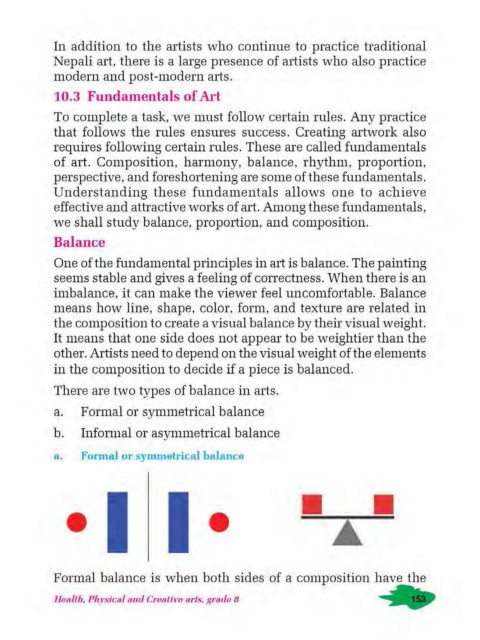
            a.    Formal or symmetrical balance


               •                             •                   •  •
                                                                       •


            Formal balance is when both sides  of a cmnposition have the
                                                                                  ~
            Tlon/Lh, Physicnl and Crrmlivo 11rl.'>, grnrln 0

