


Page 8 - D&D Bestiary
P. 8
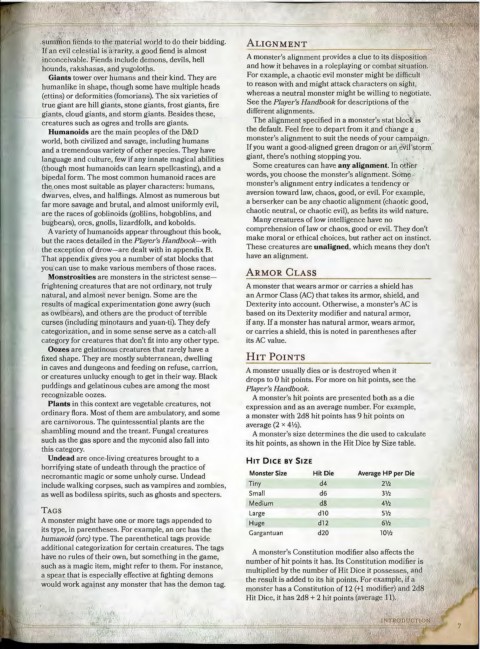
summon fiends to tne' material world to do their bidding.   ALIGNMENT
           If an evil celestial is a rarity, a good fiend is almost
           inconceivable. Fiends include demons, devils, hell   A monster's alignment provides a clue to its di~positiron
                                                             and how it behaves in a roleplaying or combat situation.
           hounds, rakshasas, and yugoloths.
                                                             For example, a chaotic evil monster might be difficult
             Giants tower over humans and their kind. They are
                                                             to reason with and might attack characters on sight,
           humanlike in shape, though some have multiple heads
                                                             whereas a neutral monster might be willing to Regotiate.
           (ettins) or deformities (fomorians). The six varieties of
           true giant are hill giants, stone giants, frost giants, fire   See the Player's Handbook for descriptions of the '
                                                             different alignments.                    ,
           giants, cloud giants, and storm giants. Besides these,   The alignment specified in a monster's stat blo~k'is·
           creatures such as ogres and trolls are giants.
                                                             the default. Feel free to depart from it and' ch'ange a
             Humanoids are the main peoples of the D&D
                                                             monster's alignment to suit the needs of your campaign.-
           world, both civilized and savage, including humans
                                                             Ifyou want a good-aligned green dragon or ari-evil'storm ·
           and a tremendous variety of other species. They have
           language and culture, few if any innate magical abilities   giant, there's nothing stopping you.   '
           (though most humanoids can learn spellcasting), and a   Some creatures can have any alignment. In ~ther
           bipedal form. The most common humanoid races are   words, you choose the monster's alignment. Some
           the ones most suitable as player characters: humans,   monster's alignment entry indicates a tendency or ''
           dwarves, elves, and halflings. Almost as numerous but   aversion toward law, chaos, good, or evil. For example,
                                                             a berserker can be any chaotic alignment (chaotic good,
           far more savage and brutal, and almost uniformly evil,
                                                             chaotic neutral, or chaotic evil), as befits its wild nature.
           are the races of goblinoids (gol:ilins, hobgoblins, and
                                                               Many creatures of low intelligence have no
           bugbears), orcs, gnolls, lizardfolk, and kobolds.
                                                             comprehension of law or chaos, good or evil. They don't
             A variety of humanoids appear throughout this book,
           but the races detailed in the Player's Handbook- with   make moral or ethical choices, but rather act on instinct.
                                                             These creatures are unaligned, which means they don't
           the exception of drow-are dealt with in appendix B.
                                                             have an alignment.
           That appendix gives you a number of stat blocks that
           you·can use to make various members of those races.
                                                             ARMOR CLASS
            -Monstrosities are monsters in the strictest sense-
           frightening creatures that are not ordinary, not truly   A monster that wears armor or carries a shield has
           natural, and almost never benign. Some are the    an Armor Class (A C) that takes its armor, shield, and
           results of magical experimentation gone awry (such   Dexterity into account. Otherwise, a monster's AC is
           as owl bears), and others ,are the product-of terrible   based on its Dexterity modifier and natural armor,
           curses (including minotaurs and yuan-ti). They defy   if any. If a monster has natural armor, wears armor,
           categorization, and in some sense serve as a catch-all   or carries a shield, this is noted in parentheses after
           category for creatures that don't fit into any other type.   its AC value.
             Oozes are gelatinous creatures that rarely have a
           fixed shape. They are mostly subterranean, dwelling   HIT POINTS
           in caves and dungeons and feeding on refuse, carrion,   A monster usually dies or is destroyed when it
           or creatures unlucky enough to get in their way. Black   drops to 0 hit points. For more on hit points, see the  '
           puddings and gelatinous cubes are among the most   Player's Handbook.
           recognizable oozes.                                 A monster's hit points are presented both as a die
             Plants in this context are vegetable creatures, not
                                                             expression and as an average number. For example,
           ordinary flora. Most of them are ambulatory, and some
                                                             a monster with 2d8 hit points has 9 hit points on
           are carnivorous. The quintessential plants are the   average (2 x 4Y2).
           shambling mound and the treant. Fungal creatures
                                                               A monster's size determines the die used to calculate
           such as the gas spore and the myconid also fall into
                                                             its hit points, as shown in the Hit Dice by Size table.
           this category.
             Undead are once-living creatures brought to a
                                                             HIT  DICE  BY  SIZE
           horrifying state of undeath through the practice of
           necromantic magic or some unholy curse. Undead     Monster Size   Hit Die    Average HP per Die
           include walking corpses, such as vampires and zombies,   Tiny       d4             21/2
           as well as bodiless spirits, such as ghosts and specters.   Small   d6             31/2
                                                              Medium           d8             41f2
           TAGS
                                                              Large            dlO            51/2
           A monster might have one or more tags appended to
                                                              Huge             dl2            61/2
           its type, in parentheses. For example, an ore has the
                                                              Gargantuan       d20            101/2
           hum~noid (ore) type. The parenthetical tags provide
           additional categorization for certain creatures. The tags   A monster's Constitution modifier also affects the
           have no rules of their own, but something in the game,   number of hit points it has. Its Constitution modifier is
           such as a magic item, might refer to them. For instance,
                                                             multiplied by the number of Hit Dice it possesses, and
           a spear that is especially effective at fighting demons
                                                             the result is added to its hit points. For example, if a  }
           would work aga~nst any monster that has the demon tag.
                                                             monster has a Constitution of 12 (+1 modifier) an'd 2cl8
                                                             Hit Dice, it has 2d8 + 2 hit points (average 11). r   ' "'
                                                                                                                 7

