


Page 146 - digitalliteracy
P. 146
7.3  Performing Initial Self-Assessments


                       How Does Your Personality Influence Your Career Choices?


                       How do you see yourself? If someone were to describe you, what would they say about you?
                       In the 1950s, John L. Holland, an American psychologist and Professor Emeritus of Sociol-
                       ogy at Johns Hopkins University, developed a theory of career and vocational choices based
                       on a person’s personality. The theory, called the Holland codes or the Holland occupational
                       themes, suggests that people do well in careers that are well suited to their personalities
                       (“Award for Distinguished,” 2008). The theory groups people on the basis of how well suited
                       they are for six different categories or personality families and lists the occupations that cor-
                       respond to each code or personality type: R = realistic, I = investigative, A = artistic, S = social,
                       E = enterprising, and C = conventional. These six types result in the abbreviation RIASEC, a
                       name by which the theory also is commonly known.

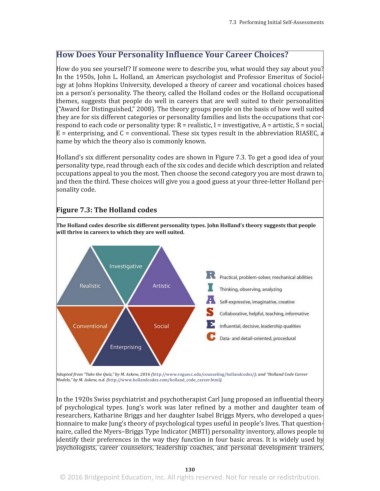
                       Holland’s six different personality codes are shown in Figure 7.3. To get a good idea of your
                       personality type, read through each of the six codes and decide which description and related
                       occupations appeal to you the most. Then choose the second category you are most drawn to,
                       and then the third. These choices will give you a good guess at your three-letter Holland per-
                       sonality code.


                       Figure 7.3: The Holland codes

                       The Holland codes describe six different personality types. John Holland’s theory suggests that people
                       will thrive in careers to which they are well suited.


                       Adapted from “Take the Quiz,” by M. Askew, 2016 (http://www.roguecc.edu/counseling/hollandcodes/); and “Holland Code Career
                       Models,” by M. Askew, n.d. (http://www.hollandcodes.com/holland_code_career.html).


                       In the 1920s Swiss psychiatrist and psychotherapist Carl Jung proposed an influential theory
                       of psychological  types. Jung’s work  was later refined  by a  mother  and daughter team of
                       researchers, Katharine Briggs and her daughter Isabel Briggs Myers, who developed a ques-
                       tionnaire to make Jung’s theory of psychological types useful in people’s lives. That question-
                       naire, called the Myers–Briggs Type Indicator (MBTI) personality inventory, allows people to
                       identify their preferences in the way they function in four basic areas. It is widely used by
                       psychologists,  career  counselors,  leadership  coaches,  and personal development trainers,


                                                                 130
                        © 2016 Bridgepoint Education, Inc. All rights reserved. Not for resale or redistribution.


       sol82612_07_m07_121-144.indd   130                                                                            6/29/16   5:15 PM

