


Page 174 - ArithBook5thEd ~ BCC
P. 174
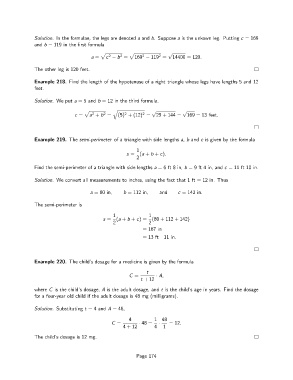
Solution. In the formulae, the legs are denoted a and b.Suppose a is the unkown leg. Putting c =169
               and b = 119 in the first formula

                                                                       √
                                           !           !
                                                                   2
                                                            2
                                                   2
                                              2
                                       a =   c − b =     169 − 119 =     14400 = 120.
               The other leg is 120 feet.
               Example 218. Find the length of the hypotenuse of a right triangle whose legs have lengths 5 and 12
               feet.

               Solution. We put a =5 and b = 12 in the third formula.

                                                                √
                                                .                            √
                                    !
                                       2
                                                     2
                                            2
                                                             2
                                c =   a + b =     (5) +(12) =     25 + 144 =   169 = 13 feet.
               Example 219. The semi-perimeter of a triangle with side lengths a, b and c is given by the formula
                                                          1
                                                      s = (a + b + c).
                                                          2
               Find the semi-perimeter of a triangle with side lengths a =6 ft 8 in, b =9 ft 4 in, and c =11 ft 10 in.

               Solution. We convert all measurements to inches, using the fact that 1 ft = 12 in. Thus


                                       a =80 in,     b =112 in,     and    c =142 in.

               The semi-perimeter is

                                                1              1
                                            s = (a + b + c)= (80 + 112 + 142)
                                                2              2
                                                             =167 in
                                                             =13 ft 11 in.


               Example 220. The child’s dosage for a medicine is given by the formula
                                                              t
                                                       C =        · A,
                                                            t +12

               where C is the child’s dosage, A is the adult dosage, and t is the child’s age in years. Find the dosage
               for a four-year old child if the adult dosage is 48 mg (milligrams).


               Solution. Substituting t =4 and A =48,

                                                       4          1 48
                                                C =        · 48 =  ·    =12.
                                                    4+ 12         4  1
               The child’s dosage is 12 mg.


                                                          Page 174

