


Page 68 - ArithBook5thEd ~ BCC
P. 68
8. −(−2) 4

                9. (10) 0

               10. (−23) 0

               11. (−1) 59

               12. 0 0


               2.8     Square Roots and Signed Numbers

               Recall that a number whose square is N is called a square root of N. 6 is a square root of 36, because
                2
               6 =36. −6 is also a square root of 36, since the product of two numbers with the same sign is positive:

                                                             2
                                                         (−6) =36.
               In general,


                                 Every positive number N has two square roots, which are
                                 opposites:
                                                                          √
                                     • The positive square root is denoted  N.
                                                                    √
                                     • The negative square root is − N.


               As usual, 0 is a special case. It has only one square root, itself:
                                                          √
                                                            0= 0.
                                                                        √
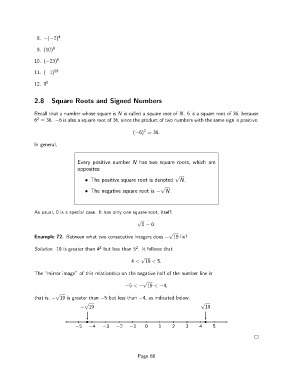
               Example 72. Between what two consecutive integers does − 19 lie?

                                           2
                                                          2
               Solution. 19 is greater than 4 but less than 5 .It follows that
                                                            √
                                                        4 <   19 < 5.

               The “mirror image” of this relationship on the negative half of the number line is
                                                             √
                                                     −5 < − 19 < −4,
                        √
               that is, − 19 is greater than −5but less than −4, as indicated below.
                                    √                                                √
                                   − 19                                                19


                                  |    |     |     |    |     |     |    |     |     |    |
                                −5    −4    −3   −2    −1     0    1     2     3    4     5


                                                           Page 68

