


Page 224 - Africanos_Wood Collections final_Neat
P. 224
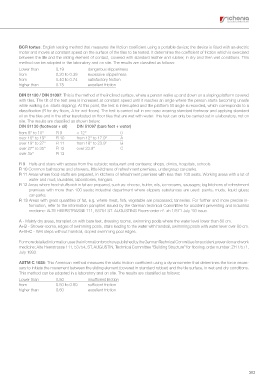
BCR tortus: English testing method that measures the friction coefficient using a portable device; the device is fitted with an electric
          motor and moves at constant speed on the surface of the tiles to be tested. It determines the coefficient of friction which is exercised
          between the tile and the sliding element of contact, covered with standard leather and rubber, in dry and then wet conditions. This
          method can be adopted in the laboratory and on site. The results are classified as follows:
          Lower than      0.19          dangerous slipperiness
          from            0.20 to 0.39   excessive slipperiness
          from            0.40 to 0.74   satisfactory friction
          higher than     0.75          excellent friction

          DIN 51130 / DIN 51097: This is the method of the inclined surface, where a person walks up and down on a sloping platform covered
          with tiles. The tilt of the test area is increased at constant speed until it reaches an angle where the person starts becoming unsafe
          while walking (i.e. starts slipping). At this point, the test is interrupted and the platform tilt angle is recorded, which corresponds to a
          classification (R for dry floors, A for wet floors). The test is carried out in one case wearing standard footwear and applying standard
          oil on the tiles and in the other barefooted on floor tiles that are wet with water. This test can only be carried out in a laboratory, not on
          site. The results are classified as shown below:
          din 51130 (footwear + oil)   din 51097 (bare feet + water)
          from 6° to 10°   R 9     < 12°               0
          over 10° to 19°   R 10   from 12° to 17.9°   A
          over 19° to 27°   R 11   from 18° to 23.9°   B
          over 27° to 35°   R 12   over 23.9°          C
          over 35°        R 13

          R 9   Halls and stairs with access from the outside; restaurant and canteens; shops, clinics, hospitals, schools.
          R 10 Common bathrooms and showers, little kitchens of refreshment premises, undergroup car-parks.
          R 11 Areas where food-stuffs are prepared, in kitchens of refreshment premises with less than 100 seats. Working areas with a lot of
              water and mud; laundries, laboratories, hangars.
          R 12 Areas where food-stuffs rich in fat are prepared, such as: cheese, butter, oils, ice-creams, sausages; big kitchens of refreshment
              premises with more than 100 seats; industrial department where slippery substances are used: paints, muds, liquid glues;
              car-parks.
          R 13 Areas with great quantities of fat, e.g. where meat, fish, vegetable are processed; tanneries. For further and more precise in-
              formation, refer to the information pamphlet issued by the German technical Committee for accident preventing and industrial
              medicine: ALTE HEERSTRASSE 111, 53754 ST. AUGUSTING Floors-order n°. zh 1/571 July ‘93 issue.
          A - Mainly dry areas, trampled on with bare feet, dressing rooms, swimming pools where the water level lower than 80 cm.
          A+B - Shower-rooms, edges of swimming pools, stairs leading to the water with handrail, swimming pools with water lever over 80 cm.
          A+B+C - Wet steps without handrail, sloped swimming pool edges.

          For more detailed information, see the information brochure published by the German Technical Committee for accident prevention and work
          medicine: Alte Heerstrasse 111, 53754, ST. AUGUSTIN, Technical Committee “Building Structure” for flooring, order number: ZH 1/571,
          July 1993.

          ASTM C 1028: This American method measures the static friction coefficient using a dynamometer that determines the force neces-
          sary to initiate the movement between the sliding element (covered in standard rubber) and the tile surface, in wet and dry conditions.
          This method can be adopted in a laboratory and on site. The results are classified as follows:
          Lower than      0.50          insufficient friction
          from            0.50 to 0.60    sufficient friction
          higher than     0.60          excellent friction


                                                                                                                303

