


Page 16 - 1916 February - To Dragma
P. 16
TO DRAGMA OF ALPHA OMICRON PI

differently. Through it all the teacher finds opportunity to help
them see why lines are especially good. Again for music they select:

                         "Russet lawns and fallows gray"
and often the harmony of the famous lines describing music:

                          "Lap me in soft Lydian airs,"
Very frequently, however, they need help to appreciate this; a fact
which affords an opportunity to point music in the vowel sounds
and in the liquid combinations and repetitions.

   From this arises naturally a little talk about the real thought of
the poem, the pleasures which Mirth offers. I f the emotions have
been stirred and pleasure derived from the poem, there remains but
one thing to be made sure, that understanding came with the feeling.
In fact the latter can hardly come without the former. A sort of
understanding usually comes. I t is, however, the crystallization of
that central thought, or teaching, and an expression of it in words,
which needs the guiding hand of the teacher. Emphasis must be
laid on the happiness coming from pure simple pleasures—met with
a mirthful heart, and L'Allegro's lesson is brought home.

   The plan for teaching / / Penseroso is practically the same.
The introductory work is not so long as there are fewer classical
allusions, since their knowledge of these has been already somewhat
refreshed and the reviews of versification has been accomplished.
There is, however, at the end of / / Penseroso a chance and a
necessity for careful comparison and contrast with L'Allegro.

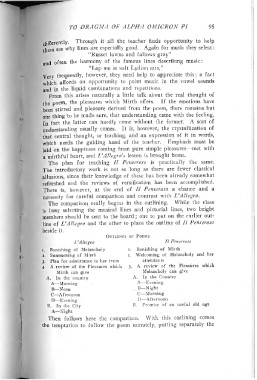
   The comparison really begins in the outlining. While the class
is busy selecting the musical lines and pictorial lines, two bright
members should be sent to the board; one to put on the earlier out-
line of L'Allegro and the other to place the outline of / / Penseroso
beside it.

           OUTLINES OF POEMS

L'Allegro                            tl Penseroso

I. Banishing of Melancholy           i. Banishing of Mirth
a. Summoning of Mirth                2. Welcoming of Melancholy and her

3. Plea for admittance to her train             attendants
4. A review of the Pleasures which   3. A review of the Pleasures which

          Mirth can give                       Melancholy can give
   A. In the country                    A. In the Country

      A—Morning                             A—Evening
      B—Noon                                B—Night
      C—Afternoon                           C—Morning
      D—Evening                             D—Afternoon

   B. I n the City                      B. Promise of an useful old age

      A—Night

   Then follows here the comparison. With this outlining comes
the temptation to follow the poem minutely, putting separately the

