


Page 54 - 1926 February - To Dragma
P. 54
TO DRAG MA OF ALPHA OMICRON PI                             217

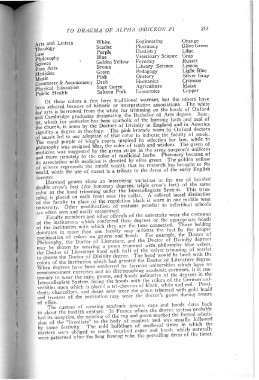
Arts and Letters        White          Engineering         Orange
Theology                Scarlet        Pharmacy            Olive Green
Law                     Purple         Dentistry           Lilac
Philosophy              Blue           Veterinary Science  Gray
Science                 Golden Yellow  Forestry            Russet
Pine Arts               Brown          Library Science     Lemon
Medicine                Green          Pedagogy            Light Blue
Music                   Pink           Oratory             Silver Gray
Commerce & Accountancy  Drab           Humanics            Crimson
                        Sage Green     Agriculture         Maize
Physical Education      Salmon Pink    Economics           Copper
Public Health

      Of these colors a few have traditional warrant, but the others have
been selected because of historic or interpretative associations. The white
lot arts is borrowed f r o m the white fur trimming on the hoods of O x f o r d
and Cambridge graduates designating the Bachelor of Arts degree. Scar-
let, which for centuries has been symbolic of the burning faith and zeal of
the church, is worn by the Doctors of Divinity in England and in America
signifies a degree in theology. The pink brocade worn by O x f o r d doctors
of music led to our adoption of that color to indicate the faculty of music.
The royal purple of king's courts inspired its selection for law, while to
philosophy was assigned blue, the color of truth and wisdom. The green of
medicine was suggested by the green stripe in the army surgeon's uniform
and more remotely by the color of medicinal herbs. Pharmacy because of
its association with medicine is denoted by olive green. The golden yellow
of science represents the untold wealth that its research has brought to the
world, while the use of russet is a tribute to the dress of the early English
forester.

      Harvard gowns show an interesting variation in the use of braided
double crow's feet ( f o r honorary degrees, triple crow's feet) of the same
color as the hood trimming under the Intercollegiate System. This trim-
ming is placed on each front near the collar. A colored tassel distinctive
of the faculty in place of the regulation black is worn in one middle west
university. Other modifications of costume peculiar to individual schools
are often seen and easily recognized.

       Faculty members and other offiicals of the university wear the costumes
of the institutions which conferred their degrees or the appropriate hoods
 of the institution with which they are the time connected. Those holding
 dotorates in more than one faculty may indicate the fact by the proper
 combination of colors on gowns and hoods. For example, the Doctor of
 Philosophy, the Doctor of Literature, and the Doctor of Divinity degrees
 may be shown by wearing a gown trimmed with philosophy blue velvet,
 the Doctor of Literature hood with half of the velvet trimming of scarlet
 to denote the Doctor of Divinity degree. The hood would be lined with the
 colors of the institution which had granted the Doctor of Literature degree.
 When degrees have been conferred by German universities which have no
 commencement exercises and no distinguishing academic costumes, it is cus-
 tomary to wear the caps, gowns, and hoods indicative of the degrees in the
 Intercollegiate System, lining the hoods with the colors of the German uni-
 versities upon which is placed a tri-chevron of black, white and red. Presi-
 dents, chancellors, and deans may wear the gown trimmed with gold braid
 and trustees of the institution may wear the doctor's gown during tenure
 of office.

       The custom of wearing academic gowns, caps and hoods dates back
 to about the twelfth century. In France where the degree system probably
 had its inception, the wearing of the cap and gown marked the formal admis-
  sion of the "licentiate" to the body of masters, and was usually followed
 by some festivity. The cold buildings of medieval times in which the
  masters were obliged to teach, required capes and hoods which naturally
  were patterned after the long flowing robe, the prevailing dress of the times.

