


Page 11 - To Dragma October 1929
P. 11
O C T O B E R , 1929                                                             9

     Keeps cjMany
"Babies Well

I t was more by circumstance

than desire that Cecile Moriarty

became a doctor. H e r parents i n -

sisted upon having a doctor i n the

family, and when her brothers

showed a determined ten-

dency for the law, the re-

sponsibility was laid on

the somewhat slender

shoulders of Cecile. Since

then her sister has entered

medicine in the field of

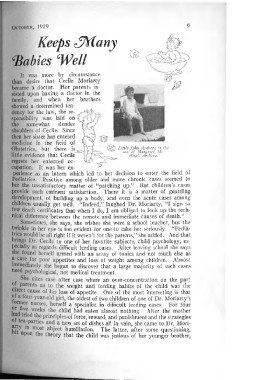
Obstetrics, but there is                              Little John Ambcrg is the
little evidence that Cecile                              son of Margaret Mc-
regrets her enforced oc-                                      Hugh Ambcrg.

cupation. I t was her ex-

perience as an intern which led to her decision to enter the field of

Pediatrics. Practice among older and more chronic cases seemed to

her the unsatisfactory matter of "patching u p . " B u t children's cases

provide such eminent satisfaction. There i t is a matter of guarding

development, of building up a body, and even the acute cases among

children usually get well. "Indeed," laughed D r . M o r i a r t y , " I sign so

few death certificates that when I do, I am obliged to look up the tech-

nical difference between the remote and immediate causes of death."

     Sometimes, she says, she wishes she were a school teacher, but the
twinkle in her eye is too evident for one t o take her seriously. "Pedia-
trics would be all right i f i t weren't for the parents," she added. A n d that
••rings D r . Cecile to one of her favorite subjects, child psychology, es-
pecially as regards difficult feeding cases. A f t e r leaving school she says
she found herself armed w i t h an array of tonics and not much else as
a cure for poor appetites and loss of weight among children. Almost
immediately she began to discover that a large m a j o r i t y of such cases
need psychological, not medical treatment.

     She cites case after case where an over-concentration on the part
o» parents as to the weight and feeding habits of the child was the
direct cause of his loss of appetite. One o f the most interesting is that
? a four-year-old girl, the oldest of two children of one of D r . M o r i a r t y ' s
lormer nurses, herself a specialist i n difficult feeding cases. For four

ha 1 1 ' i V e e k s  -he  child  had  eaten  almost  nothing.  After the mother

a tried the principles of force, reward, and punishment and the strategies

i tea-parties and a new set of dishes all i n vain, she came to D r . M o r i -

hit i m  u im              humiliation.       The latter, after some questioning,
         St a b       ect

upon the theory that the child was jealous of her younger brother,

