


Page 4 - To Dragma March 1932
P. 4
5

4 To DRAGMA                                                                  M A R C H , 1932

curred right in Cleveland. She had been doing a lot of experimental work     J
when she landed a commission to do a series of twelve pictures for the
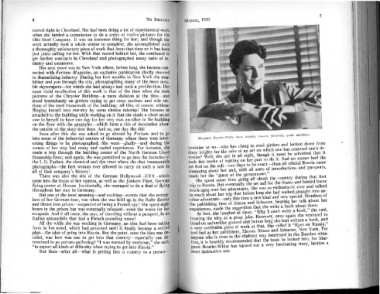
Otis Steel Company. I t was an immense thing for her; and though the         Umm*              Bourke-WkiU  loves heights, tou-ers. factories. 9reat  machines.
work actually took a whole winter to complete, she accomplished such
a thoroughly satisfactory piece of work that from that time on it has been   feminine or no—who has clung to steel girders and looked down from
just plain sailing for her. With that record behind her, she continued to    dizzy heights for the sake of an art on which one has centered one's de-
get further contracts in Cleveland and photographed many units of in-        votion? Well, she got in all right, though it must be admitted that i t
dustry and commerce.                                                         took five weeks of waiting on her part to do i t . And no sooner had she
                                                                             set foot on the soil—two days to be exact—than all official Russia came
     Her next move was to New York where, before long, she became con-       clamoring about her and, with all sorts of introductions and passports,
nected with Fortune Magazine, an exclusive publication chiefly devoted       made her the "guest of the government."
to dramatizing industry. During her first months in New York she went
hither and yon through the city, photographing many of the more nota-             She spent some time going all about the country during that first
ble skyscrapers—for which she had always had such a predilection. Her        trip to Russia. But eventually she set sail for the States and landed home
most vivid recollection of this work is that of the time when she took       much agog over her adventures. She was so enthusiastic over and talked
pictures of the Chrysler Building—a mere skeleton at the time—and            so much about her trip that before long she had walked .straight into an-
stood tremulously on girders trying to get cross sections and side sec-       other adventure—only this time a new kind and very special. Members of
tions of the steel framework of the building; all this, of course, without    the publishing firm of Simon and Schuster, hearing her talk about her
flinging herself into eternity by some chance misstep! She became so          experiences, made the suggestion that she write a book about them.
attached to the building while working on it that she made a silent secret
vow to herself to have one day for her very own an office in the building          At first, she laughed at them. "Why I can't write a book," she said,
on the floor with the gargoyles—which form a rim of decoration about          treating the idea as a great joke. However, once again she ventured to
the outside of the sixty-first floor. And so, one day she did!                tread on unfamiliar ground and before long she had written a book, and
                                                                              a very creditable piece of work at that. She called it "Eyes on Russia,"
     Soon after this she was asked to go abroad by Fortune and to go          and had as her publishers, Messrs. Simon and Schuster, New York. For
into some of the industrial centers of Germany where there were inter-         anyone who is even in the slightest way interested in the Russian situa-
esting things to be photographed. She went-—gladly—and during the              tion, it is heartily recommended that the book be looked into, for Mar-
course of her stay had many and varied experiences. For instance, she          garet Bourke-White has turned out a very fascinating story, besides a
made a trip through the building center of the North German Lloyd              niost instructive one.
Steamship lines; and again, she was permitted to go into the factories of
the I . G. Farben, the chemical and dye trust where she shot innumerable
photographs—the first woman ever allowed to carry on such a task in
all of that company's history!

     There was also the site of the German Hollywood—UFA—which
came into the focus of her camera, as well as the Junkers Plant, German
flying center at Dessau. Incidentally, she managed to do a deal of flying
throughout her stay in Germany.

     But one of the most amusing—and exciting—events that she remem-
bers of her German tour, was when she was held up in the Ruhr district
and thrust into prison—suspected of being a French spy! She spent eight
hours in the prison but was eventually released—none the worse for her
escapade. And it all came, she says, of traveling without a passport, in an
Italian automobile that had a French-sounding name!

     All the while she was working in Germany, an idea had been taking
form in her mind, which had persisted until it finally became a settled
plan—the plan of going into Russia. But the point, once the idea was de-
cided, was how was one to get into that country—especially one de-
termined to go picture-gathering? " I was warned by everyone," she said,
"to expect all kinds of difficulty when trying to get into Russia."

     But then—after all—what is getting into a country to a person—

