


Page 1030 - bahan pss1
P. 1030
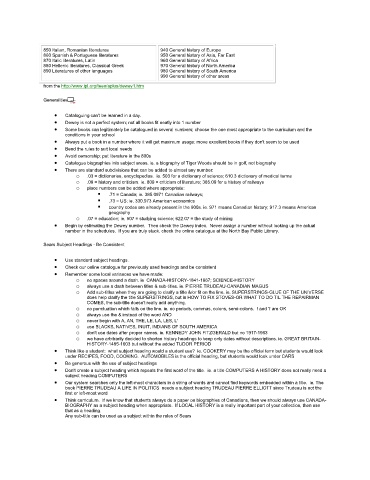
850 Italian, Romanian literatures 940 General history of Europe
860 Spanish & Portuguese literatures 950 General history of Asia, Far East
870 Italic literatures, Latin 960 General history of Africa
880 Hellenic literatures, Classical Greek 970 General history of North America
890 Literatures of other languages 980 General history of South America
990 General history of other areas
from the http://www.ipl.org/teen/aplus/dewey1.htm
Generalities
Cataloguing can't be learned in a day.
Dewey is not a perfect system; not all books fit neatly into 1 number
Some books can legitimately be catalogued in several numbers; choose the one most appropriate to the curriculum and the
conditions in your school
Always put a book in a number where it will get maximum usage; move excellent books if they don't seem to be used
Bend the rules to suit local needs
Avoid censorship: put literature in the 800s
Catalogue biographies into subject areas. ie. a biography of Tiger Woods should be in golf, not biography
There are standard subdivisions that can be added to almost any number:
o .03 = dictionaries, encyclopedias. ie. 503 for a dictionary of science; 610.3 dictionary of medical terms
o .09 = history and criticism. ie. 809 = criticism of literature; 385.09 for a history of railways
o place numbers can be added where appropriate:
.71 = Canada; ie. 385.0971 Canadian railways;
.73 = US; ie. 330.973 American economics
country codes are already present in the 900s. ie. 971 means Canadian history; 917.3 means American
geography
o .07 = education; ie. 507 = studying science; 622.07 = the study of mining
Begin by estimating the Dewey number. Then check the Dewey index. Never assign a number without looking up the actual
number in the schedules. If you are truly stuck, check the online catalogue at the North Bay Public Library.
Sears Subject Headings - Be Consistent
Use standard subject headings.
Check our online catalogue for previously used headings and be consistent
Remember some local variances we have made:
o no spaces around a dash. ie CANADA-HISTORY-1841-1867; SCIENCE-HISTORY
o always use a dash between titles & sub-titles. ie. PIERRE TRUDEAU-CANADIAN MAGUS
o Add sub-titles when they are going to clarify a title &/or fit on the line. ie. SUPERSTRINGS-GLUE OF THE UNIVERSE
does help clarify the title SUPERSTRINGS, but in HOW TO FIX STOVES-OR WHAT TO DO TIL THE REPAIRMAN
COMES, the sub-title doesn't really add anything.
o no punctuation which falls on the line. ie. no periods, commas, colons, semi-colons. ! and ? are OK
o always use the & instead of the word AND
o never begin with A, AN, THE, LE, LA, LES, L'
o use BLACKS, NATIVES, INUIT, INDIANS OF SOUTH AMERICA
o don't use dates after proper names. ie. KENNEDY JOHN FITZGERALD but no 1917-1963
o we have arbitrarily decided to shorten history headings to keep only dates without descriptions. ie. GREAT BRITAIN-
HISTORY-1485-1603 but without the added TUDOR PERIOD
Think like a student: what subject heading would a student use? ie. COOKERY may be the official term but students would look
under RECIPES, FOOD, COOKING. AUTOMOBILES is the official heading, but students would look under CARS
Be generous with the use of subject headings
Don't create a subject heading which repeats the first word of the title. ie. a title COMPUTERS A HISTORY does not really need a
subject heading COMPUTERS
Our system searches only the left-most characters in a string of words and cannot find keywords embedded within a title. ie. The
book PIERRE TRUDEAU A LIFE IN POLITICS needs a subject heading TRUDEAU PIERRE ELLIOTT since Trudeau is not the
first or left-most word
Think curriculum. If we know that students always do a paper on biographies of Canadians, then we should always use CANADA-
BIOGRAPHY as a subject heading when appropriate. If LOCAL HISTORY is a really important part of your collection, then use
that as a heading.
Any sub-title can be used as a subject within the rules of Sears

