


Page 24 - Hamlet: The Cambridge Dover Wilson Shakespeare
P. 24
I N T R O D U C T I O N         xvli

                while  mentioning  many  poets  and  scholars  of  whom
                he  approves,  he  carefully  refrains  from  naming  the
                'mechanicall mates' and 'vaine glorious tragedians,' it is
                difficult  for the modern reader to follow the drift  of his
                invective;  so that the  following  passage  in  the Preface
                has been the theme of much  controversy:

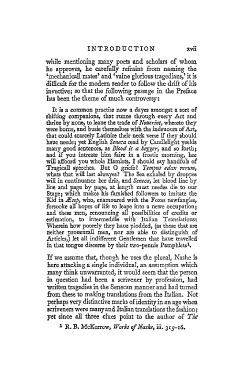
                  It  is a  common  practise now  a  dayes  amongst  a sort  of
                shifting  companions,  that  runne  through  euery  Art  and
                thriue by none, to leaue the trade  of Nouerint, whereto they
                were borne, and  busie themselues with the indeuours of Art,
                that  could  scarcely Latinize their neck  verse  if  they  should
                haue neede; yet English  Seneca read by  Candlelight  yeelds
                many  good  sentences,  as  Blood is  a  begger, and  so  forth;
                and  if  you  intreate  him  faire  in  a  frostie  morning,  hee
                will affoord  you  whole  Hamlets,  I  should  say handfuls  of
                Tragicall  speeches.  But  O  griefe!  Tempus  edax  rerum,
                whats that  will last  alwayes?  The  Sea exhaled  by  droppes
                will in  continuance  bee drie, and  Seneca,  let  blood  line  by
                line  and  page  by  page,  at  iength  must  needes  die  to  our
                Stage} which  makes  his  famished  followers  to  imitate  the
                Kid  in JEsop, who, enamoured  with  the  Foxes  newfangles,
                forsooke  all  hopes  of  life  to  leape into  a  newe  occupation;
                and  these  men,  renouncing  all  possibilities  of  credite  or
                estimation,  to  intermeddle  with  Italian  Translations:
                Wherein how poorely they haue plodded,  (as those that  are
                neither  prouenzall  men,  nor  are  able  to  distinguish  of
                Articles,)  let  all  indifferent  Gendemen  that  haue  travelled
                                                              1
                in that  tongue  discerne by  their  two-pennie  Pamphlets .
                If  we  assume that, though  he uses the plural,  Nashe is
                here attacking a single individual, an assumption  which
                many think unwarranted, it would  seem that the person
                in  question  had  been  a  scrivener  by  profession,  had
                Written tragedies in the Senecan manner and had turned
                from these to making translations from the Italian.  Not
                perhaps very distinctive marks of identity in an age when
                scriveners were many and Italian translations the fashion;
                yet  since  all  three  clues  point  to  the  author  of  The
                    1
                      R. B. McKerrow,  Works of Nashe, iii. 315-16.

